
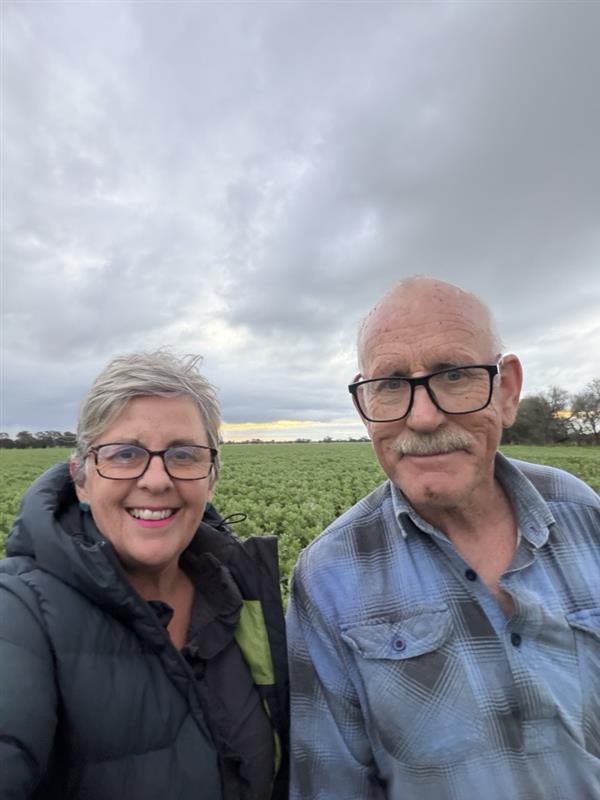
Hi, I'm Robyn Williams, and together with my husband Brendan, we farm near Bendigo in central Victoria.
No family members have shown interest in returning home at this stage so we’re in a holding pattern and have downsized operation to around 1,000 cropped acres, while a share farming arrangement manages additional country. Like many growers in Victoria, we farm across variable soil types and with seasons that rarely follow the same script twice. So we’ve learnt to stay flexible and keep an open mind about new opportunities.
This year, one of those opportunities is oats. For the first time, we've grown oats under contract for oat milk production. The oats are being grown for a Victorian processor supplying the growing oat milk sector, creating a direct link between our paddocks and an ever-changing food landscape.
Alongside cropping, we are passionate about exploring agricultural technologies and the opportunities they create. Long before drones began being used in Australian agriculture, Brendan bought himself a powered parachute.
His plan was simple enough. He wanted to take aerial photographs of crops, so he purchased the aircraft, learnt to fly it and fitted a camera underneath. It seemed like a brilliant idea until he realised the best time to photograph crops was in the middle of winter when it was absolutely freezing in the air.
Looking back, the story makes me smile because it captures Brendan perfectly. If there's a new idea worth exploring, he'll find a way to test it and that curiosity has certainly shaped much of our life together.
Recently, we welcomed a group of women from across the grains industry to our farm to see our Ornata Ag autonomous tractor in operation. As a member of the Women in Agriculture Thriving Women's Conference Working Group, it was exactly the sort of day I enjoy most. I love connecting with women who are passionate about agriculture and hearing their stories. Working alongside an incredible team of women on the WoTL conference committee has been a rich and rewarding experience. The conversations, ideas and friendships that emerge from being involved in those events are a good reminder of just how fortunate we are to work in this industry.
Having visitors on farm to see the autonomous tractor and ask questions about the future of farming reiterated how much of a constant theme innovation has been in our farming journey. People often know Brendan through his involvement in agricultural technology, but in my eyes first and foremost, he's a farmer. Every business venture, every opportunity and every new technology is measured against one question: will it help farmers do their job better?
Brendan trained as an agricultural engineer and early in our marriage we moved to the United Kingdom, where he completed a master's degree in agricultural engineering. That experience eventually took us to Jordan, where Brendan taught agricultural machinery operation while I worked as a physiotherapist in a local hospital there. It was an incredible opportunity that broadened our perspective on agriculture, communities and the different ways people make a living from the land around the world.
When we returned home, Brendan became involved in the emerging precision agriculture sector. We were there during the early days of GPS guidance technology and built GPS-Ag, one of Australia's pioneering precision ag businesses. What began as a small operation eventually grew to employ more than 50 people across Australia and New Zealand. The US parent company bought the business and then Brendan went onto developing WEEDIT technology. Ironically that business was recently purchased by the Dutch parent company.
Along the way, we've also stepped outside broadacre cropping. For four years, we owned a dairy farm near Timboon in Victoria's south-west. It was a beautiful property and an entirely different style of farming. We worked closely with managers and consultants, learnt a tremendous amount about dairy production and gained a deeper appreciation of how different agricultural industries operate. We eventually sold the dairy farm, but it left a lasting impact. Brendan still speaks enthusiastically about virtual fencing and robotic dairies, which he sees as some of the most exciting developments in Australian agriculture. We see enormous potential for technologies that improve productivity while also making life easier for farming families.
That's one of the reasons Brendan is so interested in autonomous machinery. Many people focus on the fact that a tractor can drive itself, but he tends to focus on the human benefits instead. He talks about reducing fatigue during seeding, improving flexibility and helping farmers navigate ongoing labour challenges. The way we see it is that autonomy isn't about replacing people, it's about giving farming businesses more options and helping families reclaim valuable time during the busiest parts of the season.
Like most farming families, we've experienced our share of highs and lows. Some business ventures exceeded our expectations. Others didn't quite work out. Agriculture has a way of teaching resilience. Seasons don't always go according to plan and neither does business. The important thing is learning from every experience and continuing to move forward.
For me, what continues to stand out about agriculture is the people. Through farming, industry events and my involvement with the Thriving Women's Conference, I've met some extraordinary people. Grain growers are problem-solvers by nature. We adapt, innovate and find ways to move forward regardless of what the season delivers. That's what makes me proud to be part of the Australian grains industry. Our growers operate in some of the most variable conditions in the world, but we continue to innovate and remain globally competitive.
Every season demands countless decisions, constant adaptation and a willingness to embrace change. After more than three decades with Brendan, we have chased plenty of ideas, from powered parachutes and GPS technology to optical spot spraying and autonomous tractors. Not every idea has worked perfectly - but every one of them started with the same motivation: a belief that farming can always be improved.
And if there's one thing I've learnt on our journey, it's that the future belongs to those who are curious enough to explore it.