
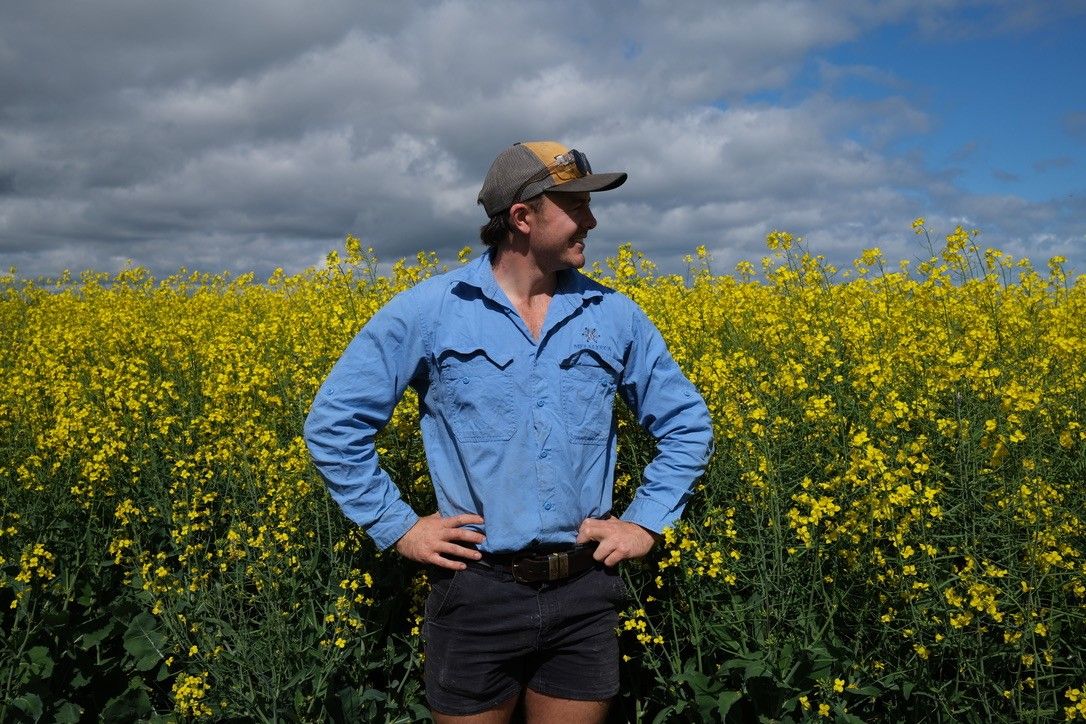
My name is Samuel Smart, and I run our family farm alongside my father, mother, sister and wife Tess. We are located just north of Dongara, which is about four hours north of Perth on coastal farmland about 1km away from the coast.
We farm 800 hectares consisting of predominantly self-mulching clay soil, and then the rest of our land consists of black-wattle soil, which is sandier profile but can still provide an adequate yield.
My father did a lot of the groundwork setting up over the last five years, and this year the focus has been for me to take on a more managerial role in the decision making on the farm and let him step down. With guidance from my father as well as Kim Fleay this transition has been enjoyable and rewarding, but not without its speed bumps.
This season is shaping up as a good one for us, particularly after the most recent rain event which was 60ml to push us over the 100ml mark for August. The recent rain has made up for how unpredictable the start of the season was. We had a bit of rain in early May and sowed a smaller paddock which had to later be reseeded in June with the rest of the program once the rains started. Since then, the weather has been on our side, and this season has just kept exceeding our expectations.
We’ve only farmed this land for the past five seasons so we’re still trying to figure out what the optimal rotation is, and now we’re trying to rotate between canola, wheat and barley, whilst also looking to implement a legume that is compatible with our soil types so we can get more nitrogen and nutrients into the soil organically. The soil we have is highly alkaline so we can’t grow a traditional lupin to try and get nitrogen fixing into the soil.
We were early adopters of drone spraying technology, it was something that really stood out to my dad and I. We have two drones, a DJI Agras t-50 and t-100, and we use them together to do majority of late season spraying if the season permits. This season, the drones were invaluable as it allowed us to reseed a canola paddock where the germination was sub optimal, allowing us to increase the plant numbers and profitability of that paddock.
We value up to date equipment on our farm. Having modern gear increases efficiency as well as reduces downtime, meaning I can maximise productivity without needing an extra set of hands in busy times throughout the year. I understand my unique position which allows me access to these machines, and I am very fortunate to run machines of this capacity on a farm of this size.
We also do a lot of soil and fertiliser testing with our fertiliser supplier to make sure we have prepared and fed the ground and then plant enough to optimise our yield and the quality of the grain. This has led to major gains for us as we were previously severely phosphate deficient.
Being coastal, another issue we face is pests. Given where we are situated, the main pest we have to deal with is snails. We manage snails with an intensive baiting regiment prior to rain which is overseen and conducted by my sister.
The high input costs at the start of this year influenced our decision-making. We left out about 5% of our crop because we knew those paddocks would have been too much work and not given enough reward.
No matter year, the heavy country will always be cropped as they are guaranteed to grow a good enough crop to break even on. Even if we had less rain this year, it’s still worth planting because even if the tonnes aren’t there, the quality makes up for it.
With only 800 hectares, this farm gives myself and my wife Tess great work life balance. Sure, seeding and harvest are still busy, but the rest of the year is manageable. Future proofing for not only a successful farm but also a successful family life is a major focus for me. I have been fortunate enough to see the effects of larger broadacre farms and the stresses they project onto families and mental health. It is a focus of mine to continue farming whilst mitigating the attachment to the farm that is associated with broadacre cropping.
For the next few years, the priority is to optimise and understand this farm as well as we can.
I particularly want to work on our weaker soils like the black wattle soil and optimise that, while also making sure, we’re getting the best out of the self-mulching soils.
I believe the future of farming in my area will always be impacted by input costs, but in the next five to ten years, a lot of the big established farms in the greater area will transition to a new generation with sons and daughters taking over.
I believe this fresh change of new blood will bring innovation as my younger peers within the area are passionate about farming and are willing to learn as well as take the risks to find innovation and practices.