
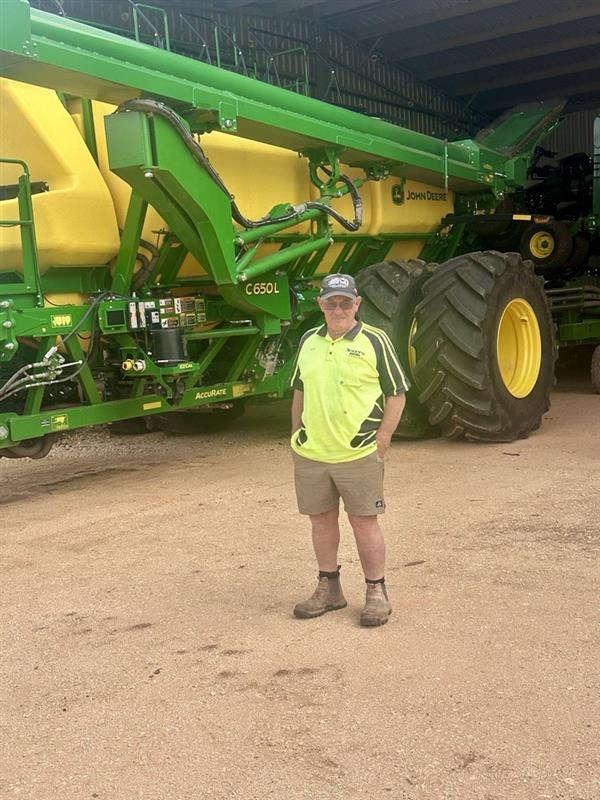
Hi, I'm Terrence "Jacko" Kiley and I farm west of Sea Lake in Victoria's Mallee with my wife Vonda and our family. These days there are three generations involved in the business, including our sons Zane and Tyrone, Tyrone's wife Allison, our daughter Brianna, her husband Mick and our grandson Ethan.
I'm a third-generation farmer and have been farming for around 53 years. Out of nine boys in my family, I'm the only one who remained on the farm. Today, we crop about 10,700 hectares of cereals, canola and lentils across country ranging from sandy loams through to heavier clay soils.
We've had a very wet late winter and early spring this year, which caused a bit of waterlogging in some of our lentils, but overall the season has been terrific. We picked up 12 to 15mm of rain a couple of weeks ago, which was excellent. Since then it has dried out a little, but the cereals look outstanding and the canola is shaping up well.
To be honest, I don't think I've seen it look better.
At the moment, we're about a month away from harvest. The focus right now is on cutting and processing hay, baling, desiccating crops and getting everything ready for grain harvest. It's a busy time of year and there's plenty happening across the farm.
Compared with last season, I think yields will be better, but it's certainly been a much more expensive crop to grow. Input costs are probably 20 to 25 percent higher than they were a year ago, so while production prospects are strong, profitability is still very much front of mind.
The biggest issues I'll be watching over the next 12 to 24 months are fertiliser costs, fuel prices and succession planning. Like most growers, fuel and fertiliser have become major expenses.
Succession planning is another big focus for our family. With multiple family groups involved, it's not something that happens overnight. We've been working through the process gradually putting arrangements in place. I can see myself slowly unwinding over time and the next generation taking on greater responsibility.
One thing I've seen change dramatically throughout my farming career is the way we farm in the Mallee. Back when I started, there was a lot more livestock, a lot more fallow and plenty of dust storms. We were often working on longer rotations and carrying sheep as part of the system. The move to no-till farming in the early 2000s completely changed that.
We adopted no-till in 2003, around the same time we introduced GPS guidance. It revolutionised farming in our region. We moved towards continuous cropping, soil condition improved and the dust storms became far less severe than what we used to experience. Our average wheat and barley production has increased significantly since those days. The benefits across productivity and soil conservation have been enormous.
That transition didn't happen by accident. We learnt a lot from agronomists, field days, study tours and looking at what growers were already doing in places like the Eyre Peninsula and Western Australia. Having good advice and a willingness to learn made a huge difference.
Alongside no-till, we're continuing to invest in improving our country. We're doing a lot of soil amelioration on sandhills and trialling different approaches to manage saline discharge areas, including trees and perennial grasses. Some of that work is still experimental, but we're always looking for ways to improve the land for future generations.
Technology continues to evolve too. We've used Weed-It technology for around 10 years and now run John Deere See & Spray systems. We haven't gone down the path of autonomous tractors, swarm bots or drones yet, but we're keeping an eye on how those technologies develop.
Looking ahead, what excites me most is still the same thing that excited me when I first started farming. I genuinely enjoy growing crops. The margins are tighter than they've ever been and there's no shortage of challenges, but there is still something incredibly rewarding about seeing a crop come through and achieving a good result.
I also enjoy seeing the next generation become involved in the farm. Ethan has recently completed his Certificate IV in Agriculture and it's encouraging to see the younger members of the family developing their skills and passion for the industry. I think they'll adapt to whatever comes their way.
Agriculture has always been about adjusting to challenges, embracing new ideas and looking ahead, and I'm confident the next generation is well equipped to continue doing exactly that.