
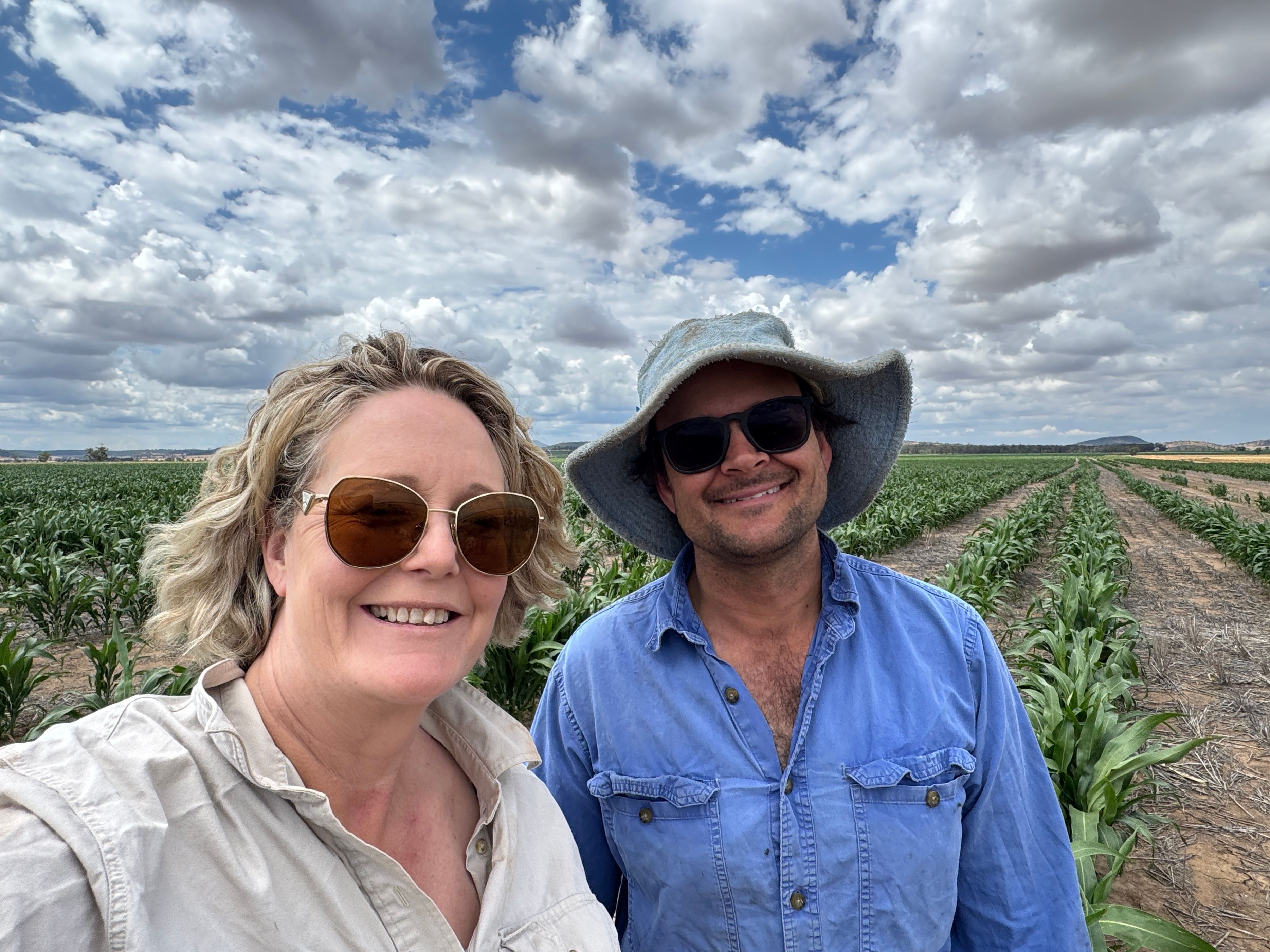
Hi, we’re Tony and Sharon Single and we farm alongside our three young children Madge, Sadie and Clarrie, on our property Narratigah about 50km southeast of Coonamble in New South Wales.
After many years farming in partnership with Tony’s parents, John and Mary, we’ve recently stepped into the role of running the family farming business. Tony’s family has farmed Narratigah across four generations, and we both come from multigenerational farming families. We’re proud to build on the work of Tony’s parents and the generations before them.
We run a mixed farming operation across 6,500 hectares, including a zero-till cropping program and trade cattle enterprise. We crop up to 4,500 hectares, with wheat, chickpeas and canola generally making up our winter program, while sorghum is our main summer crop.
Our rotation isn't fixed, our crop choices are driven by starting soil moisture at a given planting opportunity, while following solid agronomic sequencing. Having flexibility is important to manage variability of rainfall. We've also grown barley, durum and faba beans in the past, which can be options depending on the season and markets.
This year, we only received 280 millimetres of rainfall to September, it was an extremely dry summer and effective rainfall didn’t really occur until late May, that pushed back our planting and ruled out a lot of our short fallow.
Because of this we only planted about 20 per cent of our cropping area, growing wheat and chickpeas. Coming off the back of five strong seasons, we didn't have a lot of long fallows available, and we weren't hitting our moisture targets across many paddocks, though we were pleasantly surprised that some of the short fallow did refill well enough to plant.
In our environment, having moisture targets and understanding when to plant is critical. Sometimes you need to take a degree of risk, but growing crops on suboptimal moisture can lead to poorer results than long-fallowing to the next season. Managing that risk is one of the most important parts of farming in our region.
While it was a short-growing season, the in-crop rainfall we did receive was effective, and even with above average temperatures our long-fallow wheat averaged 4.8 tonnes. Chickpeas were 1.1 tonnes, despite being on quite sodic soil and significant losses due to wildlife. The short fallow wheat ranged from 2.2 to 3.5 tonnes per hectare.
In terms of agronomy, insect and disease pressure was low, that reduced in-crop input costs. Weed control was mainly through pre-plant residuals, and our pre-plant nitrogen program was in place before the price hikes.
For us, weed management is one of the biggest challenges we face, and certainly one of the largest costs if we get it wrong. We are highly moisture reliant so we run a zero-till system and prioritise keeping fallows weed free to conserve moisture. Tony’s family developed the Single Agriculture Weed Mapper technology, so we’ve had access to drone-based weed mapping for several years. Tony has added an additional spot-spray line to our booms, allowing us to put out a broadacre spray and targeted spot spray on the same pass using different mixes. This means we can more efficiently target our weeds in a timely fashion, while remaining cost-effective.
As herbicide resistance continues to be a challenge for growers, technologies like this are becoming increasingly important in helping us make better decisions and improve our outcomes.
When we think about future opportunities for the grains industry, automation is often the first thing that comes to mind.
While in the future it will have its place, right now we are more focussed on efficiency through strategic investment in machinery and infrastructure. For instance, we maintain the resources to spray every hectare of the farm in seven days. Timeliness of operations is the number one profit driver in our environment.
We're also excited about the opportunities emerging through plant breeding and grains research. Outside of the farm, we’ve both worked as agronomists and prioritise keeping up to date on the research coming through and factoring it into management decisions.
Sharon is a Trustee for the NSW Wheat Research Foundation and sits on the advisory board for the University of Sydney’s Plant Breeding Institute. Through that involvement, we've seen firsthand the significant gains plant breeding continues to deliver for growers. The progress made over recent decades in improving yield potential, disease resistance and adaptation to challenging seasonal conditions has been remarkable.
It allows us to remain optimistic about the future and about our ability to continue producing food efficiently over the next 10 to 20 years.
We’re both incredibly proud to be Australian grain growers. We come from strong family farming backgrounds and have always been passionate about agriculture, both through our off-farm careers and now through our work on the farm. Family legacy is important to us. It’s pretty special to be able to continue what our predecessors started and, hopefully, continue improving into the future.
Australian grain growers are among the most efficient producers in the world, backed by the best researchers in the world. Our ability to improve water-use efficiency and grow more with less year after year is something we should be proud of.
More broadly, it's the people that make this industry so rewarding. The lifestyle, the family connections and the communities we're part of make us feel extraordinarily fortunate. It's a wonderful industry to be involved in, and we're excited about what the future holds.