
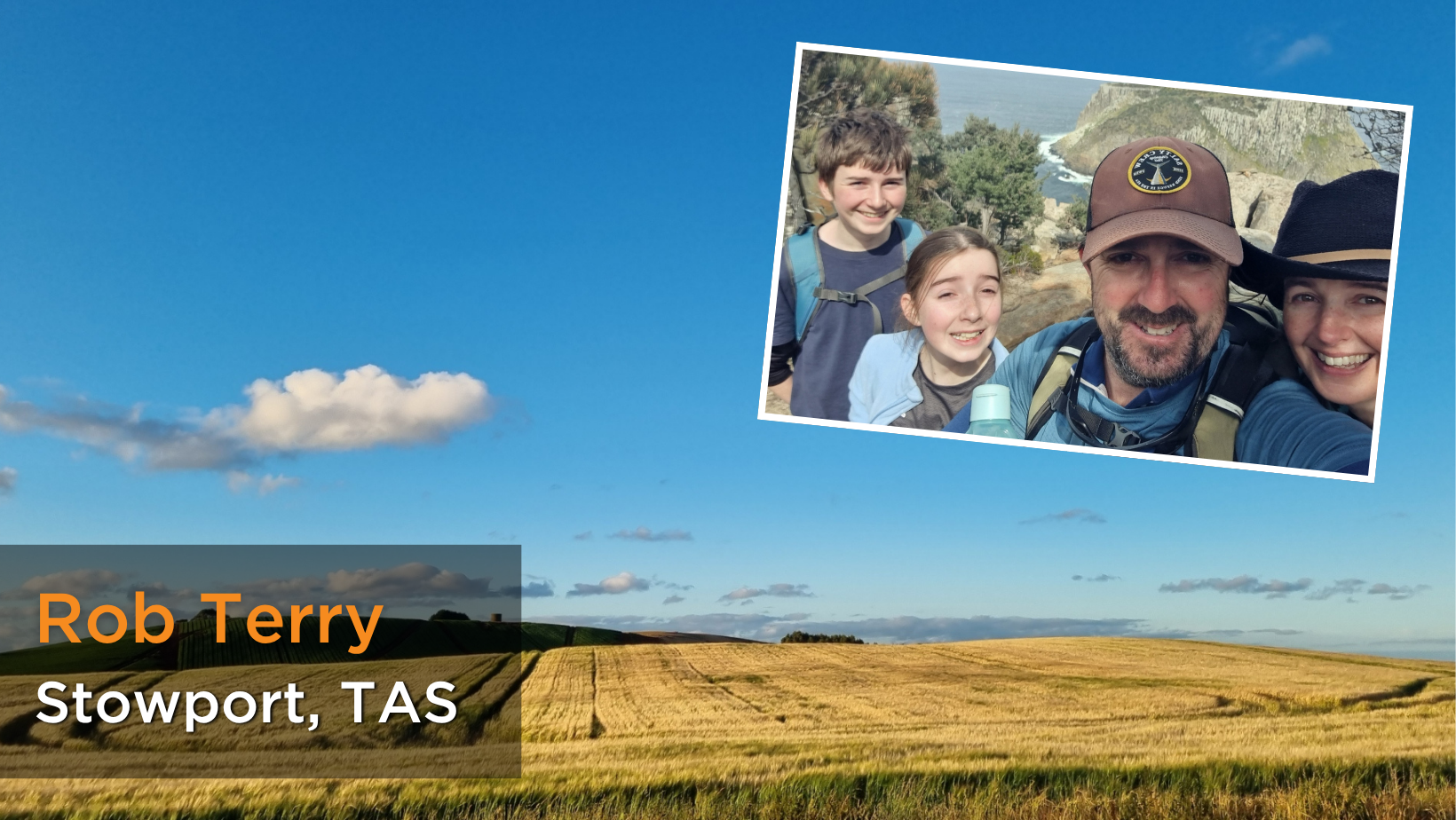
Hi, I’m Rob Terry and I’m based in Stowport, about six kilometres from the ocean, just east of Burnie, in Tasmania. I farm here with my wife Veronica and two teenage children.
We farm on 54 hectares, where our soils are red ferrosol and free draining. We typically get about 1200 mm of rain a year.
In the past we have grown potatoes and vegetable crops and have just taken a step back from that while keeping grain in the system and growing more. We have also stepped back from our locally focussed contract harvesting business. We are now mainly concentrated on cropping cereals and canola and introducing a livestock component to the farming operation.
The main reason behind this change was that I wanted a break from the intensity of horticulture and to try do things a little bit differently. The war in the Middle East has obviously driven input prices up significantly, and horticulture has an extremely high use of fertiliser and diesel. I just thought it was time, so we decided to sell some land which gave us the opportunity to simplify our structure. We wanted to have a different approach to life, and so far, it’s been good.
This season, one thing we are doing differently is direct drilling our canola, which is not conventionally done around here. So far, we have had a good strike of the canola. We do get some slugs here in the crops, but we bait at planting and as soon as the first one emerges. So, we seem to have got on top of the slugs relatively well.
We were already set up with most of the gear we needed, however we did need to select a direct drill. That’s been interesting as not all the drills have worked in our soils. It’s pretty soft and light and we have gone with a tine drill which surprised me. Finding the right drill has been a bit of a battle, we have had a few contractors with different drills that were meant to be the bee's knees but didn’t end up working for us.
We are going down about four inches deep with the tine drill and putting a good channel below. The canola loves to be able to tap moisture availability. We are on sloping country and the biggest thing we want to get away from is erosion. So far, the tine drill has been very helpful in mitigating the erosion.
This year, our rotation will be about three quarters wheat with the rest to canola, plus grazing for the cattle. We are bounded by a conservation area, so a big project for us now is upgrading the wallaby fencing in that section. It needs an apron on the fence to keep the wallabies off the crop and paddocks.
We are also looking at soil mapping our farm. We have used composts in the past and one thing we are looking at trying this year is maximising our mineralisation. We are starting to get into that, because with horticulture you blanket fertilise everything so there's no variable rate. Once it’s done, we will be able to look more at a variable rate application of fertiliser in the future, to reduce our inputs.
For our fertiliser program, we will pre-spread 100 kilos of DAP and then come back over the top with urea and SOA and our fungicides and then back up with irrigation. I think that’s going to be good for this year, as we are aiming for between three to five tonnes per hectare for the canola.
In terms of the wider industry, I'm employed with a Natural Resource Management organisation at the moment. Through this role, we have just taken part in a massive project with CSIRO, mapping local soil profiles as part of a project around Australia. We were involved in some remote areas in Tasmania, and it was very interesting to get a profile of all the soils. Through my involvement, the biggest thing I find is a lot of information about sustainability and other industry advances are not getting to farmers. While there is a lot of talk about it in the organisation and at a government level, farmers don’t always understand what's coming their way.
I’m also on a board as a Director of Southern Farming Systems for Tasmania and I also sit on a Strategic Investment Advisory Panel (SIAP) for Hort Innovation. Southern Farming Systems and Hort Innovation have access to the latest and greatest information helping to advance both industries.
I would like to see changes to make products more readily available for farmers, especially in available chemistry. New chemistries are obviously improving by becoming more efficient, better for the environment and the people using it, so why not make it available as quickly as we possibly can? We’re not getting new chemistry quick enough, and I think there needs to be a gateway where if it's approved in New Zealand or in the EU that has very similar standards to us, we can have access to it earlier.
Looking to the future, I’m focused on sorting out our direct drilling and really pushing our yields of irrigated cereals. I'd love to go six tonnes of canola and get to 12 or 13 tonnes of wheat per hectare.
Our other priorities over the next three to five years alongside improving direct drilling, is to increase our biodiversity and even potentially look at some farm stay accommodation. We have got a beautiful section of bush that looks down the gorge, and we may be able to put in some accommodation on that piece of land as another way to diversify our income. Hopefully, we will be able to take advantage of the opportunities that arise.