
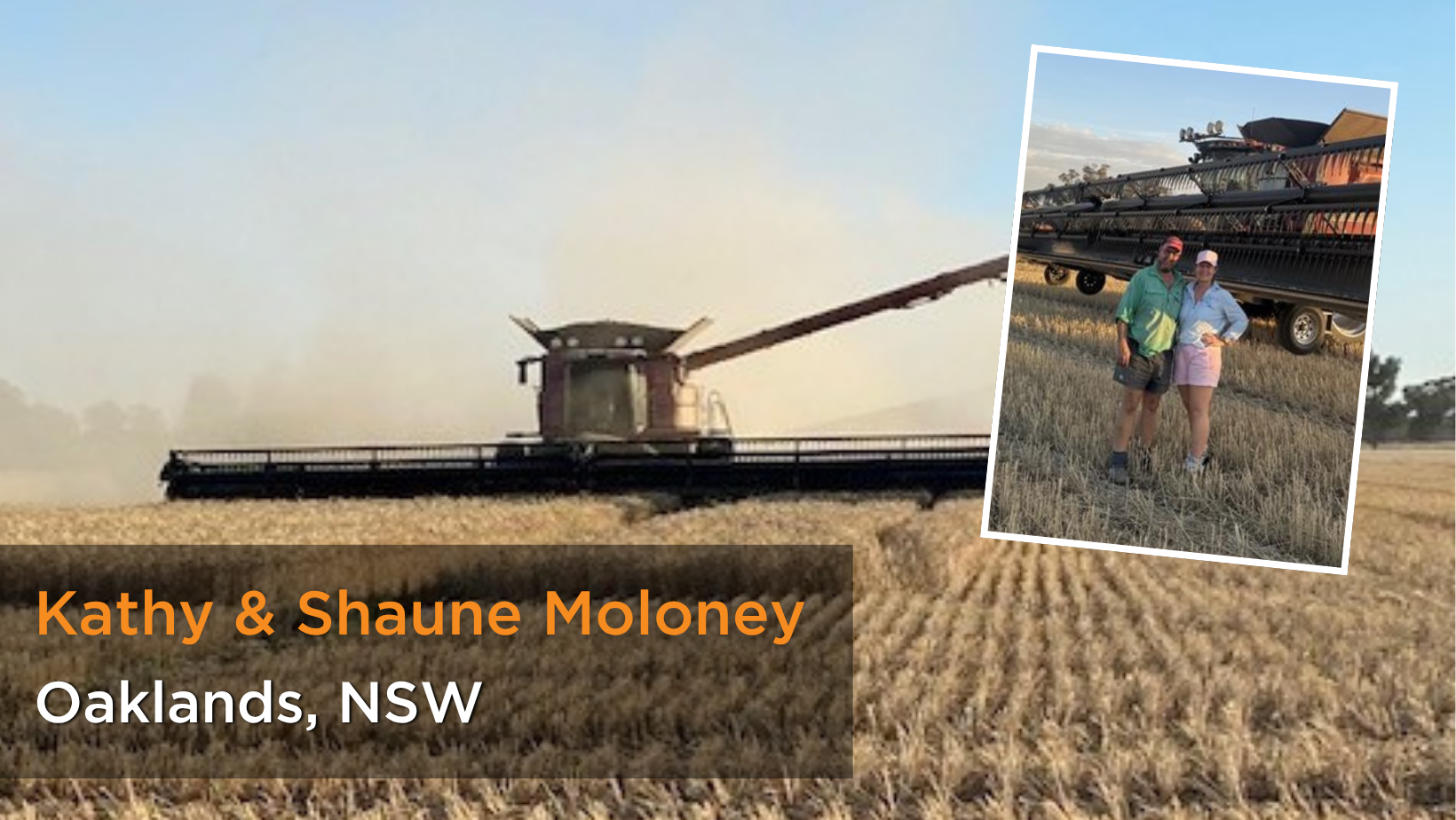
Hi, we’re Kathy and Shaune Moloney and we farm at Oaklands in the Southern Riverina. We’re both fourth-generation farmers and farm on the property Shaune’s family first settled on in 1906, so it’s been in the family for 120 years. Shaune’s parents are still involved in the business and, while they’re not out on the farm every day, they still like to know exactly when it’s raining.
So far, the season is shaping up quite well. Our canola, wheat and barley went in on time or only slightly behind schedule, and significant rain through June, followed by another good rainfall event in early July, has set us up well for winter. We’re currently busy top dressing and spraying weeds, and if we can get some follow-up spring rain, we’ll be well placed heading into harvest.
We're actually well ahead of last year's rainfall totals at this point, which is encouraging. Because we were so dry coming into the season, the country has soaked the moisture up pretty well and we've been able to stay on paddocks without getting bogged. At this stage, we're just hoping for some spring rain to finish things off.
Like many growers, we're always weighing up economics and agronomics when making decisions. We do see pulses as part of our program and have grown legumes including vetch and faba beans in the past. But after a few dry finishes and looking at what stacked up financially, we decided to stick with the three traditional crops - canola, wheat and barley - grown in the area for this season.
Our operations have certainly evolved over time. Shaune’s family used to grow rice and run Merino sheep, but after the millennium drought, we moved away from rice production and eventually concentrated more heavily on cropping. We do still run around 60 Angus cattle on some smaller paddocks that aren't suited to cropping. We also use a small amount of irrigation to establish pasture for the cattle, but these days we're predominantly a dryland operation.
Technology has also changed the way we farm. We’ve been using no-till and minimum-till systems for many years now, which has been a game changer. The biggest thing for us is making decisions using the right information. Soil testing and working closely with our agronomists help us make informed decisions and effectively plan ahead.
One of the advantages of our location is access to grain storage and markets. We have about 3,000 tonnes of on-farm storage, which allows us some flexibility around marketing, and we’re close to several receival sites as well. Our location also gives us plenty of marketing options. Grain can head into dairy and feedlot markets, Melbourne, or move north depending on where demand is strongest. Having those markets around us is a real advantage.
We’re both heavily involved in our local community and one event that’s particularly important to us is the annual Riverina Harvest Ball. It started more than 20 years ago as a way for growers to meet the people they were speaking to on the phone during harvest, whether it was the local grain marketer or service technician. Over time, it’s grown into a major event that brings together hundreds of people from across the region and gives everyone a chance to connect away from the paddock.
What makes the event so special is that a lot of the proceeds go back into the community. Funds have supported local facilities, community groups and projects, and it’s become something we all really look forward to each year.
Family is also a big focus for us. We have three daughters, Amelia, Skye and Harriet, who are all weekly boarders in Albury and return home to play sport for the local football and netball clubs on weekends. Amelia, our eldest, is interested in pursuing tertiary ag studies after school, and while there's absolutely no pressure for any of the girls to return to the farm, we'd love to see them build careers somewhere within the industry.
It's exciting to see agriculture opening up more opportunities for young people, particularly young women. Kathy works off-farm with WoTL (Women Together Learning) and is currently coordinating their annual conference for women involved in agriculture. Being involved in a group that creates opportunities for women in agriculture to come together and learn is right up our alley, especially with three young daughters and a strong passion for our local community.
We are proud to be Australian grain growers because we play a role in feeding not only the nation, but the world. Harvest is probably our favourite time of year. It’s when you see all your hard work and planning come together, and there’s a real sense of satisfaction in that.
Farming certainly has its challenges, but it's also an industry that never stands still. We're constantly learning, adapting and looking ahead to what's around the next corner. That's what keeps it interesting and why we're proud to be part of the industry.