
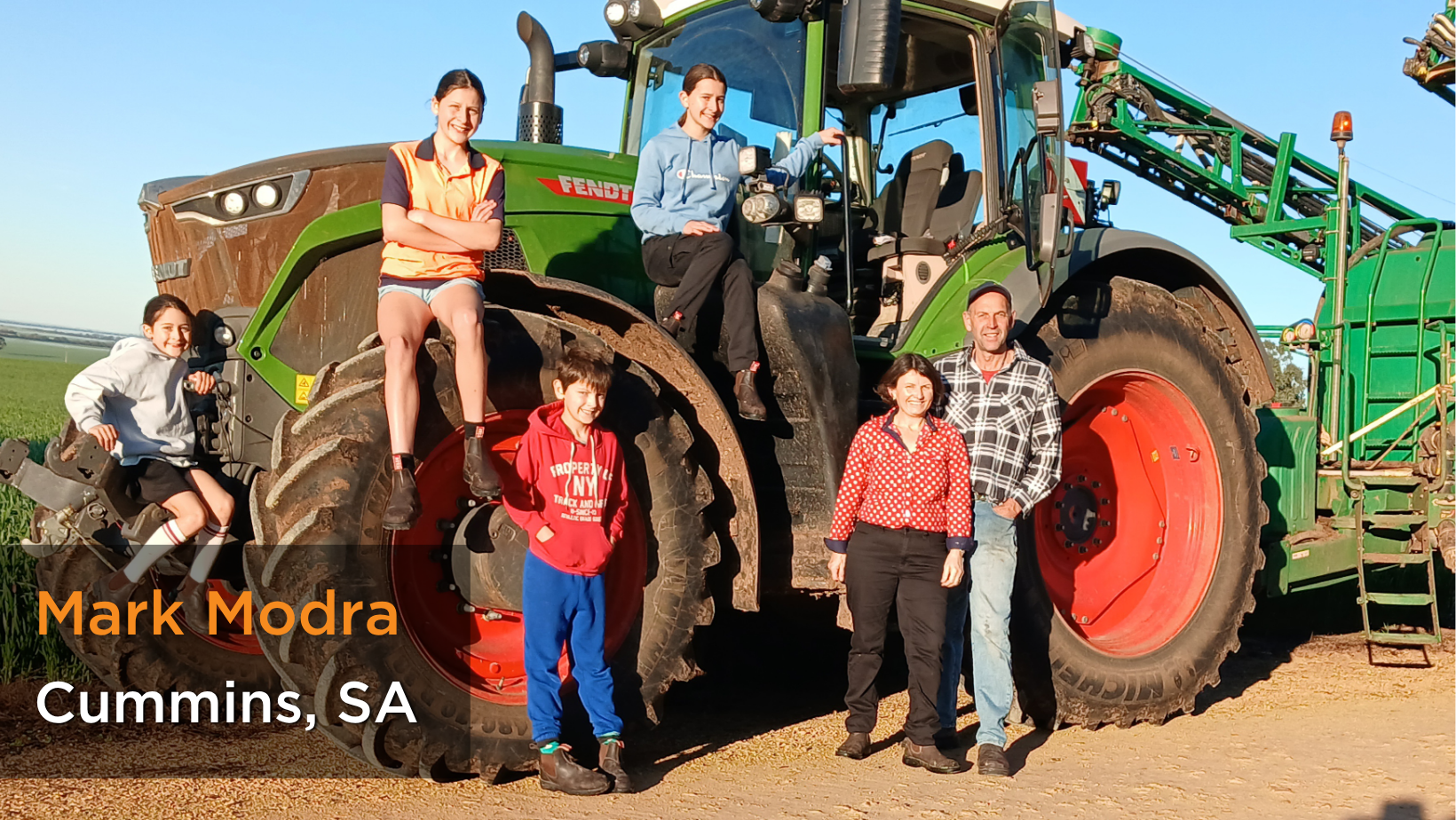
Hi, I’m Mark Modra and I farm with my family at Cummins on the Eyre Peninsula in South Australia. We crop around 1,100 hectares and run a small sheep enterprise.
I’ve been farming for 30 years and while I’m now based around Cummins, I grew up on Thistle Island, where my family ran between 4,000 and 7,000 sheep across 10,000 acres. Life on the island was a little different to most farming operations. Everything had to be brought in by boat or plane, and everything had to leave the same way. Dad was a pilot, so our aircraft became the equivalent of a farm ute, transporting everything from sheep through to motorbikes and welders.
Eventually, my parents sold the island and moved back to the mainland. Dad had always enjoyed the machinery side of farming and wanted to transition into cropping.
Today, I am based in the lower-middle part of the Peninsula and farm across a range of soil types and rainfall zones. The Eyre Peninsula is incredibly diverse. In our area, we receive between 400mm and 500mm of annual rainfall, with rainfall increasing the further south you go. Our soils range from buckshot, sand and loam to more premium red-brown earths, which is some of the best cropping soil on the Peninsula.
A lot of our southern country was traditionally better suited to sheep, but various soil amelioration practices such as ripping and spading have allowed us to crop that country in a far more reliable and profitable way. Managing soil pH is also a major focus because our leaching sands can create their own acidity issues over time.
We're having a good season so far, although like all growers, we've been keeping a close eye on costs and margins. Our rotation is generally legumes, cereals and then canola. This year, however, I significantly reduced my wheat area, with only about 10 percent of the program going into wheat and the remainder planted to lentils and other legumes.
This decision was based on looking at my gross margins and realising I couldn’t make money out of my southern country with the high fertiliser prices. So, I decided to put lentils and other legumes there instead, as we don’t apply any urea with lentils. For lentils, we should be able to get two to three tonnes per hectare, so I’m happy with that.
We also run a few sheep, which are not only profitable but useful for managing weeds. If we have a paddock where weeds, particularly chemical-resistant ryegrass, are becoming a problem, the sheep can help clean that up before we bring the paddock back into crop. They're also a great way to get our kids involved in farm life.
In terms of automation, I think at first it will be useful as a labour-saving tool, but over time, it will open up opportunities for different weed control systems. Technologies such as optical sensors, targeted spraying, microwave technology, autonomous inter-row cultivation and other non-chemical approaches become much more practical when you can slow the machinery down and improve precision.
I think there are a lot of good technologies out there that don't quite work until you take a step back and look at things differently. I think we've become very focused on covering more hectares, faster. Sometimes the answer might actually be slowing down and doing things differently.
Within the wider industry, I’m involved in a few different ag groups, which I find very useful for sharing information or bouncing my ideas off other people. I’m currently involved in Air EP and the GPSA Policy Committee. I also really enjoyed my time on GRDC’s Regional Cropping Solutions Group, as there were some pretty switched on farmers and agronomists within that group that I learnt quite a bit from.
I’m also part of the Nuffield Network, having completed my Nuffield scholarship on the industry’s reliance on chemistry and herbicides. It’s a great group to be a part of because people are willing to think outside the square, challenge ideas and have their own ideas challenged in return.
My wife, Tamara, is actively involved in the farm. She manages much of the bookkeeping, helps with homeschooling some of our children and, when she's not busy with those responsibilities or community commitments, helps out on the machinery as well.
Community is a very important aspect of our farming life. There’s a saying that it takes a village to raise a child and I strongly believe in that.Our family is involved in local football and netball clubs, and we support the SA Country Fire Service and church where we can. I do believe that a community can’t thrive unless we all do our little bit to help hold it together.
Looking ahead, I’d like to have more systems in place on our farm that reduce our reliance on chemistry and provide additional tools for weed management. For me, it's about building a farming system that is both profitable and sustainable over the long term.
What makes me proud to be a grain grower is being part of an industry that is constantly learning, improving and working together to solve problems. We don’t just focus on the bottom line; we also recognise the importance of supporting the communities that underpin Australian agriculture.