
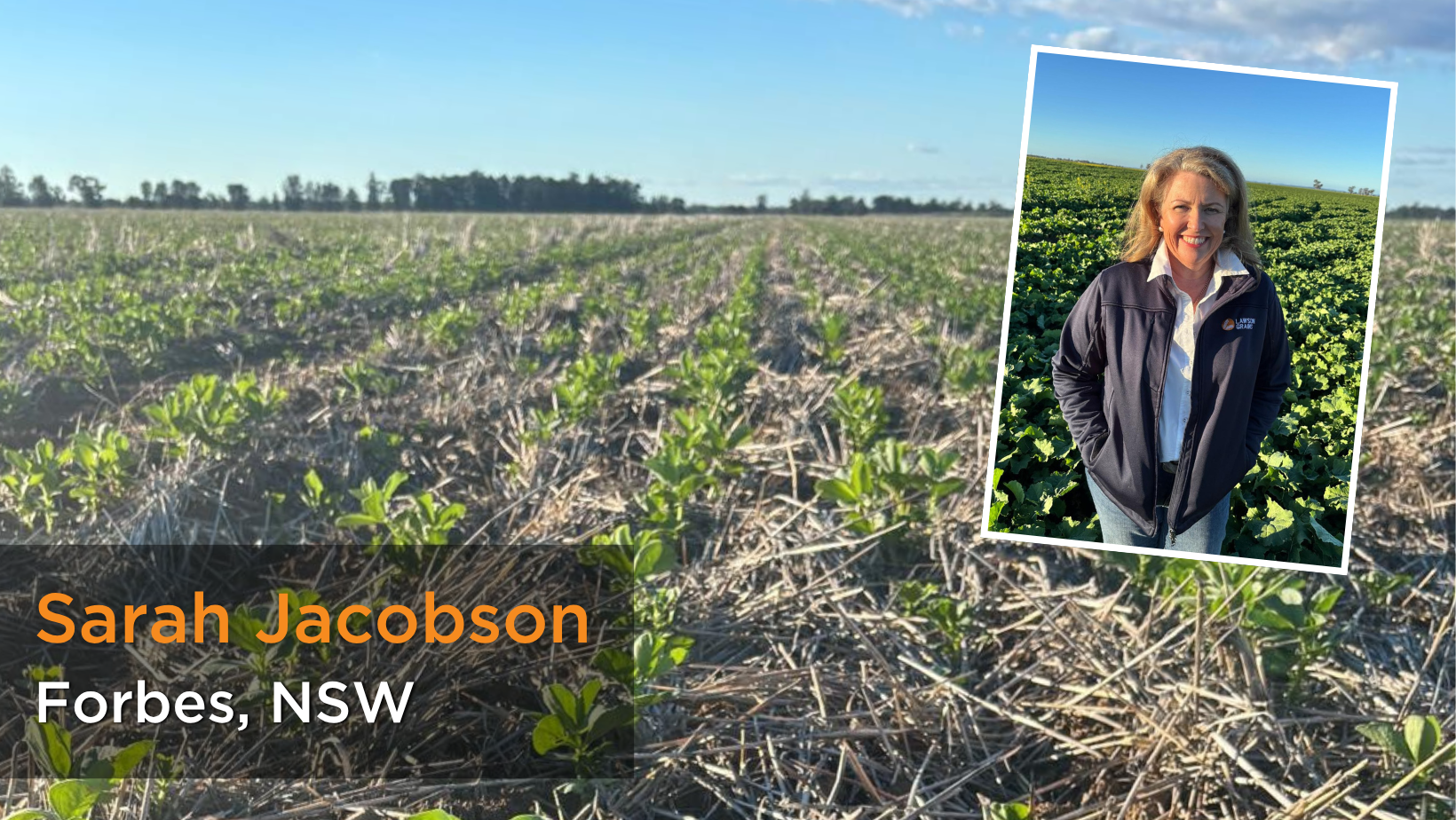
Hi, I’m Sarah Jacobson and I’m based in Forbes in Central West NSW.
I work for Lawson Grains, a corporate farming business with operations across New South Wales and Western Australia and a total landholding of more than 100,000 hectares. We are predominantly a cropping business, growing wheat, barley, chickpeas, canola, faba beans, lupins, lentils, sorghum and some irrigated cotton across our operations.
I work as part of the analyst team at Lawson Grains, focusing on research and development, crop production and more recently, understanding and measuring our carbon emissions. With a background in agronomy, I’m passionate about turning research and data into practical opportunities that help improve the way we farm.
While Lawson Grains operates across 11 properties, historically my focus has been on our Central West operation. It’s where I live and what I see out the window every day. One of the greatest strengths of the business is its geographical spread. Having farms spread across multiple regions helps us manage risk, whether we’re dealing with variable rainfall, frost or other climatic challenges that can impact production.
So far, this year has been a real rollercoaster across our NSW operations. In Northern NSW, the season began with prolonged dry conditions before much-needed rain arrived and turned things around. Meanwhile, Southern NSW is shaping up considerably better than last year thanks to a combination of good rainfall and warmer temperatures. In fact, it’s the best our district has looked in a long time, which is encouraging. However, these favourable conditions also bring new challenges, including the potential for increased disease pressure as we head into the rest of winter and into spring.
One area we’ve seen significant change over recent years is our crop rotation. Across most of our farms, we’ve increased the proportion of pulses in the rotation, with some making up around 25 percent of the cropping program. This is beneficial not only for nitrogen fixation, but also disease breaks and improving weed control.
Of course, introducing new crops does come with its trade-offs. Growing anything for the first time means you do have to go through the phase of learning and understanding what the best varieties, timing, and establishment methods are. We aren’t afraid to fail and are willing to explore new opportunities to see what works. For example, we’ve recently been trialling lentils in WA and expanding our faba bean program in NSW. This season, that decision paid off, as the faba beans were able to be established before persistent wet conditions kicked in.
Another major focus has been understanding and addressing soil constraints. As production has steadily increased over the years, managing soil variability has become even more important. We see a real opportunity to better understand and manage the different soil profiles to get the best crop production possible.
We’re involved in a range of industry trials and regularly work alongside the GRDC and several universities. As a larger organisation, we have the data collection capabilities that research projects and trials often require. Since 2018, we have been running a long-term soil amelioration project with the University of New England on our farm in Forbes to better understand how different soil management approaches can improve productivity at scale.
As a result of the trial, this year we’ve been able to incorporate organic matter deeper into the soil profile. We’ve been trialling deep ripping and placing products such as compost granules, chicken manure granules and lime-gypsum blends at depth. The results from small plot trials have been encouraging enough that we’re now testing these approaches at paddock scale.
I find it fascinating how different regions adapt solutions based on local circumstances. In Southern NSW, it makes economic sense to use chicken manure granules sourced from Griffith. In Central West NSW, locally produced compost products are more practical. Meanwhile, in WA, some of our farms have access to poultry operations, making chicken manure compost readily available and cost-effective. To me, that’s what a circular economy is really about – making the most of resources available in your local community.
Another key part of my role, is looking at how we can reduce and monitor our greenhouse gas emissions while using the data we already collect on farm to explore opportunities along the supply chain. It’s an area I’m particularly passionate about, and while I think it’s a growing opportunity within the industry, I would still describe it as a work in progress.
At the moment, it can be quite complex to navigate, particularly as requirements often differ depending on whether grain is destined for domestic or export markets. For export markets, there are multiple frameworks and market requirements to consider. However, as these systems mature and growers start to see clearer commercial benefits, I think adoption will naturally increase. Like many changes in agriculture, it can seem overwhelming at first, but over time, it becomes part of doing business.
Reflecting on my own career, one of the most rewarding aspects has been seeing research and ideas translate into practical on-farm outcomes. Having previously worked as an agronomist, I always wanted to test and apply the concepts I had recommended to others. Working with Lawson Grains for the past 12 years has given me that opportunity. My husband and I have been able to manage one of the properties ourselves and have been involved in expanding the business, which has been incredibly rewarding. I’ve been fortunate to work for an organisation that has allowed us to treat the farm as our own, particularly as we don’t come from a family farming background.
At the end of the day, I think agriculture is such a fulfilling industry to be part of. It’s also encouraging to see the number of young people entering the industry who are willing to grow and develop their skills. Their optimism and willingness to embrace new opportunities gives me great confidence in the future of the Australian grain industry.