
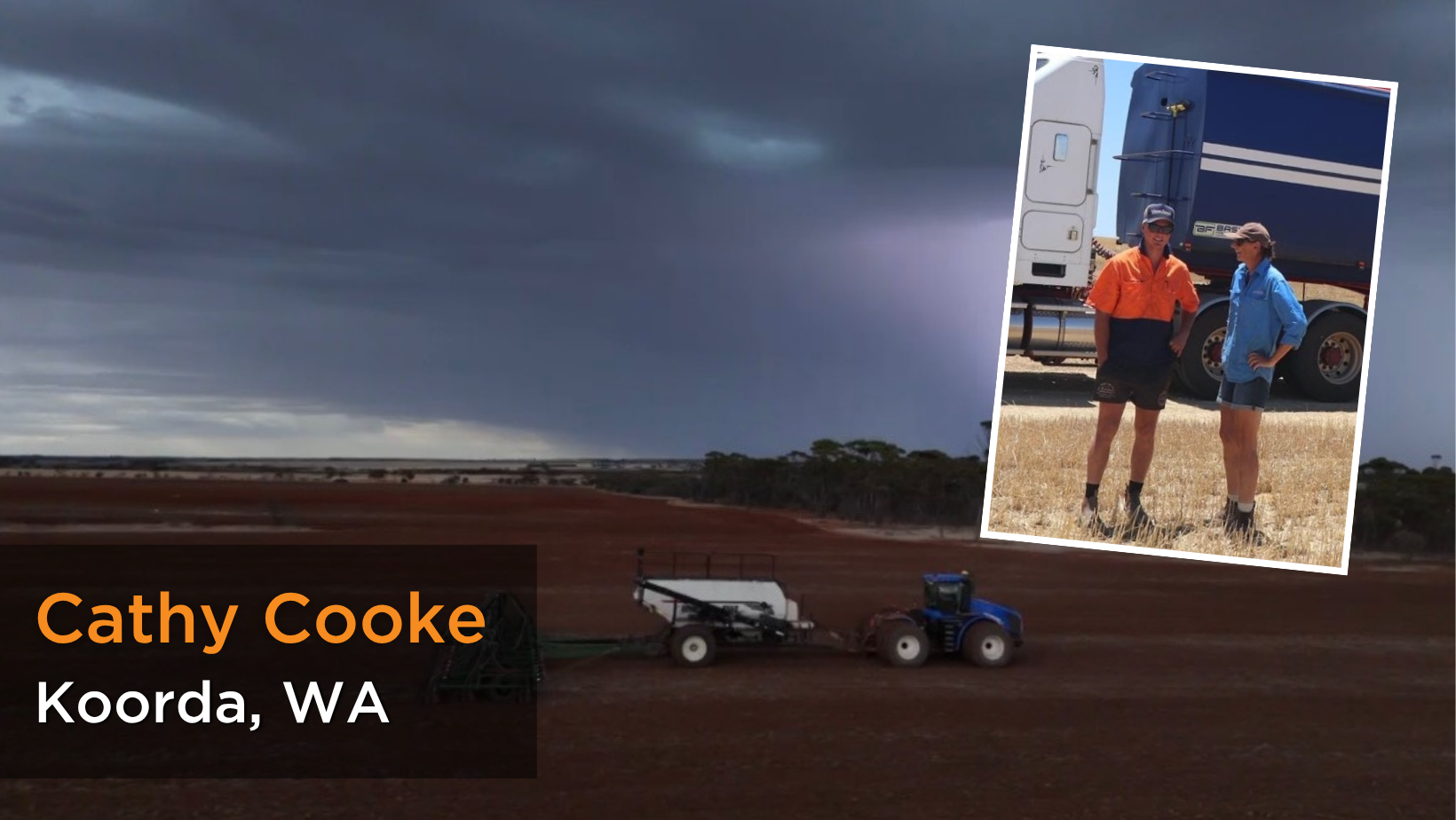
Hi I’m Cathy. I farm with my family north of Koorda and we’re planting somewhere around the 9000 hectares this season. I farm with my husband Peter and our son Sandy, who is back on the farm after working away for a couple of years. Our daughter Hayley is living down south working for Nutrien.
I don’t come from farming, I grew up in Perth. Peter grew up in Boyanup and his folks sold their dairy farm when he was young. He came out to this area to work for a farmer and when he met me, he had identified that there were no trucking companies out here.
He bought a truck and that's when we started a trucking business. We were able to lease some land and then buy some land and that's where we started back in the mid-nineties.
We still have trucks and back in 2023, we had a very below-average season. We went back driving and carted wheat at harvest time for other clients. We sent my son away with a truck down south, so we use the trucking business as a contingency plan.
We have expanded a lot; we started with a couple of thousand acres on our first block that we leased. I think we're never scared of scared of an opportunity. We definitely have no issues with a bit of risk.
It's been amazing for us to come into an industry that we both were really passionate about. We wanted to have a crack at farming; it’s living the dream if it's what you want to do.
We started seeding this year with a slight reduction in our input. Given the start of the year, we pulled the programme back a little bit to reflect that.
We were starting to wonder at what point was our break-even costs, so we pulled back on the lime and we'll leave those few paddocks out this year. We were a bit short on N, so we just thought well, we'll do what we do better, and we'll make up for it next year in the grain from the fallow.
Our average rainfall is around 200 to 250ml and the majority of our soil type is a red, sandy loam. Around our lake country is loam and then anything high up is a sandy Wodjil type soil.
Right now it’s pretty dry, we've had good early rain which is very nice. But it is pretty dry now and looking forward is a little worrying because there's nothing on the horizon. But we're still full steam ahead with seeding.
System wise, we haven't changed anything this year. We’re running two DBS and we have increased our liming over the past eight years. We’ve really geared up on lime; we're applying a few thousand tonnes a year.
We're starting to see some really good results now, especially in the top 10cm and now we're just trying to address sub-soil ph.
We started deep ripping approximately eight years ago and now we've also got a Horsch Tiger to improve that process. It’s been very good; we're seeing a yield response in the first year.
Our fallow component always gives us a really good result in the year after a break, so that's right for next year.
We run sheep but we still call it a fallow on those paddocks. We are running cattle too, so we take the advantage of keeping those paddocks reasonably clean.
We doubled our lupin programme this year, and I have a feeling that a few people might have put a few lupins in around the shire. We put a fair bit more canola in as well with the rain that we got from cyclones Mitchell and Narelle.
We have been trying new wheat varieties. I'm really interested in wheat with long coleoptile. I’ve moved away from Calibre as a variety and we’re looking at other options.
The most gains to our area are with GM Canola. The amount of GM Canola that goes in versus TT varieties is now huge. The hybrid vigour we get with GM Canola out in the lower rainfall area, and how tough it is as a plant is exceptional.
We grow lupins with the sheep in mind, and we also grow oaten hay for export, but we also keep a reasonable amount of that hay for the sheep as well.
We try to be organised, and we have pretty good fertiliser infrastructure. In a year like this, we were lucky that we always can hold a bit of grain and cart that down in January to the port. We pick our compound fertiliser up then, so we had all our compound on hand before we start seeding.
We mapped the farm a lot over the years, we've done variable rates for N and compound, but more recently we've actually gone away from that.
I didn't think with the small variation that we were varying it; we were getting a return that I was happy with. I just felt that you need to be varying it a lot more to see results.
We were only varying it at 20:40:60 and I don't think it's a big enough variation to achieve what we were hoping to achieve.
Other things we do for sustainability is we plant about 10,000 trees every year, pretty much we always have, and we always put in salt bush as well. And we’ve also just done some deep drainage, some of our lake country needed a bit more defining to tidy it up a bit. We've got rid of some old fashion level banks, trying to stop that recharge so it just never ends really.
We’re looking at new technology and would like to do more, but for now we’re taking a wait-and-see approach.
We plan to revisit it when we upgrade our sprayer. Our two current sprayers are still doing the job, but it’s something we’ll consider in the future.
We look at the future, and I always talk to other farmers, I can't help myself. I joined the GRDC on the Western Panel last September. I love hearing what people are doing, also when you drive past a farm and think, what's this person done here? I am always keen to find out why people were doing things on their farm.