
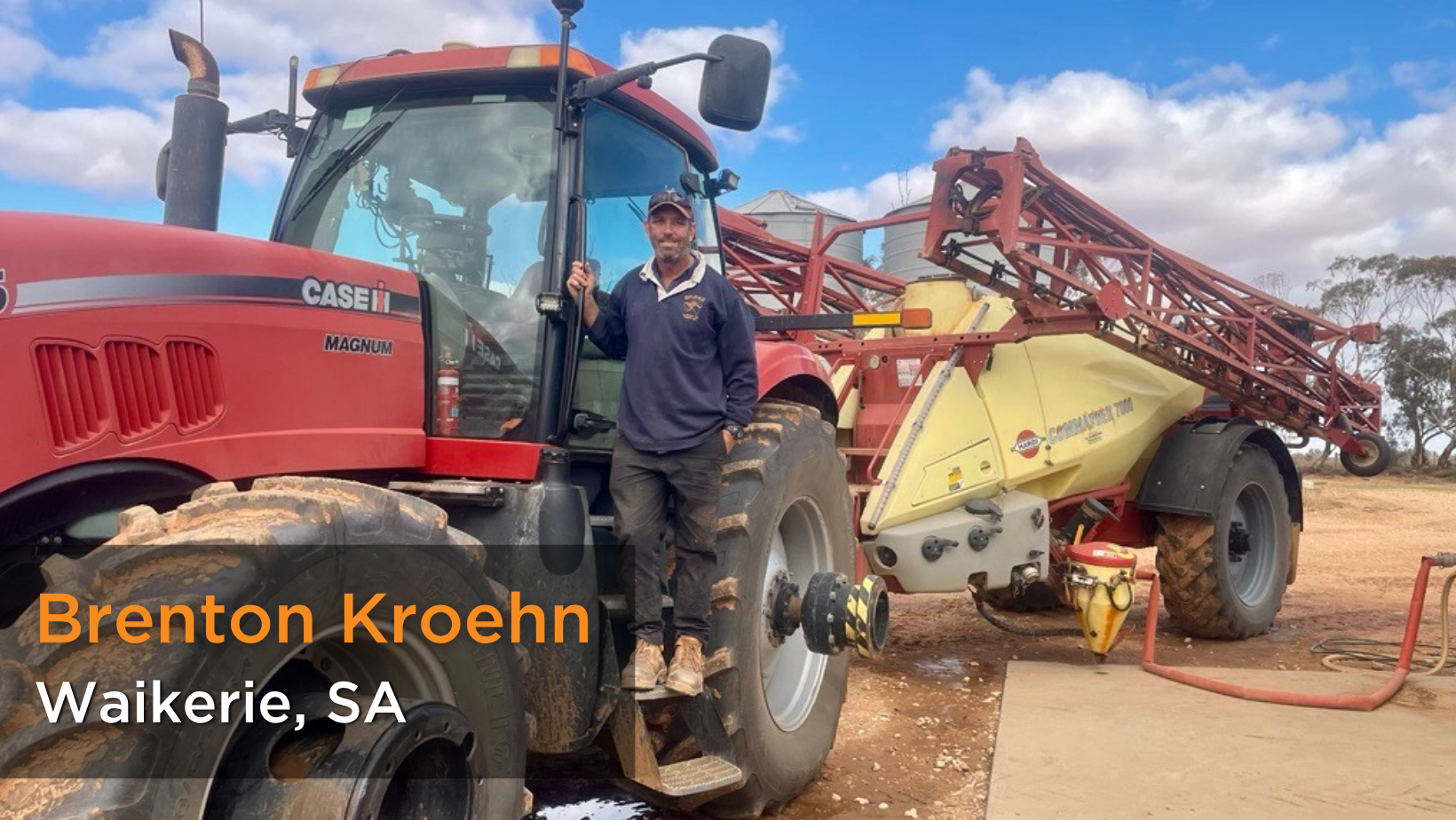
Hi, I’m Brenton. I farm with my wife Penny, about 10 kilometres south of Waikerie in South Australia’s Riverland, on low‑rainfall country that traditionally averages around 250 millimetres in a good year — although we haven’t seen that for a while.
Our total farm holding is about 4,600 hectares, with roughly 2,600 hectares that we manage ourselves. The soils are mainly sandy loam with limestone through them, along with lighter sandhills and some rocky areas. It’s productive country when conditions line up, but it’s also vulnerable — especially when rainfall is low and the wind doesn’t let up.
The Riverland is a diverse region. Alongside dryland cropping and livestock, we’ve also got citrus and vineyards, and it’s an area where a wide range of farming systems operate side by side. In low‑rainfall environments like ours, understanding your country and matching your system to it is critical.
The past few seasons have been challenging from a rainfall perspective. Growing‑season rainfall was just 97 millimetres in 2025 and less than 91 millimetres the year before. This growing season, we’re sitting at around 120 millimetres so far. Most of that has come since March, which has been welcome, but it’s also been patchy across the regions.
Like many proactive growers in the area, we’ve been running minimum‑till or no‑till systems for years — stubble retention, double knock where needed, minimal soil disturbance and a strong focus on ground cover. Those practices absolutely help, and they’ve been proven time and again through local trials. That said, last season showed that even the best systems can be pushed beyond their limits. With very little bulk, bare patches developed, sandhills blew and paddock damage occurred across the region — regardless of how well things had been managed.
This year, there’s been a lot of careful decision‑making around levelling paddocks, managing weed burden and balancing erosion risk with getting ground back into shape. In my case, I cultivated some late‑sown paddocks purely to level them off after last year’s damage, waiting until rain arrived before opening things up. Timing is everything.
My cropping operation these days is very targeted and livestock‑focused. I’m planting oats and vetch for sheep feed and hay, and about 700 acres of barley that we’ll harvest and store to use through our confinement system if needed. Any surplus grain gives flexibility depending on the season. As well as sowing, we are lambing at the moment rebuilding ewe numbers after the drought. The March rains have made a big difference to feed availability, and it’s been encouraging to see good green pick coming through. With almost half the property leased, our cropping program now supports the livestock enterprise first and foremost.
Soil health remains a key focus for us, so we’re maintaining strong rotations and being conservative about when and how we disturb paddocks. On light soils like ours, protecting structure and minimising erosion risk is critical.
When we started talking about how the system had evolved over recent seasons, and what had changed on farm, it made me reflect on how much the workload itself had shifted over time.
A couple of years ago, I realised that while seasons played a part, the workload was becoming overwhelming. At the time, we were running a large cropping program, a substantial livestock enterprise and a stud operation. I had a full-time employee who had been with us for 15 years and even with good people around me, I always felt like I was constantly chasing my tail.
Eventually, I had to be honest with myself. The workload wasn’t sustainable for the long term. I reached out to my business adviser and asked a simple question: Can you help me make a plan to change?
That conversation led to a full business review, looking closely at risk, workload, staffing and long‑term viability. What I wanted was a lower‑risk system — one that didn’t rely heavily on cropping, major machinery investment or ongoing staff, and one I could realistically manage on my own.
We made the decision to lease out around 2,000 hectares to another local grower and restructure the business around livestock. Today, it’s just me running the farm.
I still work part‑time for the grower leasing the land, helping with seeding and harvest. It gives me an income stream, keeps me in the game, and suits both of us.
I didn’t realise how busy I’d been until things came back into balance. I’m still working hard, but I’m no longer overwhelmed. My headspace is clearer, I’ve got more energy, and I’m enjoying farming again. I’ve had time to get back into sport, focus on fitness, and spend more time with family and community — things that matter just as much as what happens in the paddock.
The hardest part of the change wasn’t the numbers or the logistics. It was the mindset shift — giving myself permission to do things differently and that wasn’t easy, particularly as a third‑generation farmer, carrying a strong sense of legacy and responsibility to the business and the land. But it was necessary.
If there’s one thing I’d say to other growers feeling under constant pressure, it’s this: talk to someone you trust and get another perspective on your business. Sometimes sustainability isn’t about pushing harder, it’s about reshaping the system so you, your family, and the business, can keep going.
Everyone’s journey is different, but we are all on the same path. What matters is finding a system that’s sustainable for your land, your business and your headspace. We produce quality food in tough environments. We care deeply about our land. And we’re good at adapting when we need to and that’s what makes me proud to be an Australian grain grower.