GrainGrowers Market Update
Interest rates hit 18-year high – adding to financing and leasing costs
On 3 November, the Reserve Bank of Australia (RBA) increased the cash rate by 0.25% to 4.85%, its highest level in 18 years. The increase followed higher-than-expected inflation.
The industry’s exposure to increasing borrowing costs is material. ABARES reported that the value of debt held by grains farms had been increasing by 6% per annum over the last decade. As of 2025, the grains industry held in aggregation – more than $55 billion in loans and leases. These substantial loan balances mean higher interest rates remain an important issue for the industry to monitor.
Usually, an Australian interest rate rise would typically be expected to strengthen the Australian dollar. However, the dollar is trading at around US$0.69, below where it started the week as messaging from the RBA softened around further lifts.
Oil drops 13% in a week due to US election
Oil markets responded to the US midterm election results. On 4 November, West Texas Intermediate (WTI) crude fell below $90USD/barrel a barrel for the first time in a month. Prices dropped nearly $8USD/barrel, or 8.3%, in a single day, from $96.09USD/barrel to $88.12 USD/barrel.
WTI subsequently recovered slightly to $90.20 USD/barrel but remained well below the $104.12 USD/barrel recorded at the start of the week—a decline of approximately 13.4%.
The fall followed Democratic success in the midterm elections, with markets anticipating an easing of tensions involving Iran and the Strait of Hormuz.
Lower oil prices will be welcome news for Australian growers as harvest progresses, a peak period of on farm fuel demand.
Canola prices continue to fall – exacerbated by the oil price
As of 6 November, canola prices are trading at $753.20CAD/tonne, their lowest level since early July. Prices have fallen from $788.40CAD/tonne on 2 November—a decline of approximately 4.5% in less than a week.
The decline mirrors falls in both the soybean and palm oil markets. Lower oil prices have placed downward pressure across the oil adjacent commodities, including canola, European rapeseed, palm oil and soybeans.
Increase in Chinese demand and a potential peace deal combine to hold wheat prices steady
Wheat prices briefly fell below 600USd/bushel this fortnight, also reaching their lowest level since July. They are currently trading at around 600.5USd/bushel.
Recent downward pressure on wheat prices has reflected renewed hope of a potential peace agreement involving Ukraine and Russia - brokered by the USA. Such an agreement could ease export flows from the region and increase the availability of grain on global markets.
Indications this week that Beijing could expand its purchases of US agricultural commodities beyond soybeans to include wheat and reports out of Russia that wheat exports are forecast to fall 6% this year provided some market price stability.
These factors helped support prices around 600USd/bushel.
Rain is delaying winter harvest but helping improving summer crop prospects
As Australia’s harvest progresses, growers are also facing wet conditions like those experienced in Canada only two months ago.
Over the past week, more than 25 millimetres of rain has fallen across the Great Southern and parts of Western Australia’s Wheatbelt, parts of the Eyre and Yorke peninsulas, much of Victoria, and cropping areas of New South Wales extending into Queensland.
The rain is delaying harvest and could potentially affect crop quality and yield. The industry is closely monitoring both the impact of the November rainfall and any future rain out to December.
Rain in northern New South Wales and Queensland could also improve the outlook for summer cropping. Plantings had initially been expected to fall below the 10-year average amid concerns about El Niño, but these recent rainfall events could support stronger summer crop plantings across northern cropping regions.
Argus Media Fertiliser Report
Urea
Australian importers and resellers reported little buying activity in the last week as grain growers continued focus on the winter crop and many growers delayed fertiliser purchases until crop returns became clearer.
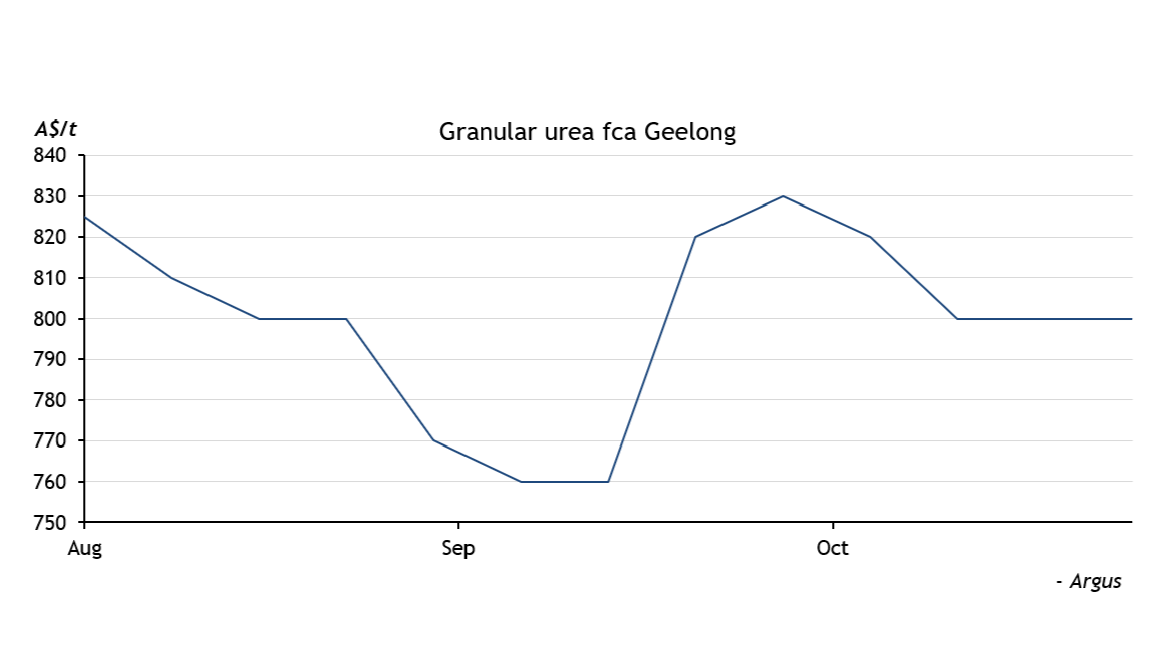
Granular urea was assessed unchanged at A$790-810/t fca Geelong with little change in domestic demand during the week.
Northern grain growing regions of Queensland and northern New South Wales received up to 150mm of rainfall in the past week. Improved soil moisture boosted sentiment for summer crops, particularly cotton, importers said. The continued rainfall could trigger a new round of fertiliser purchasing.
Cotton growers have already secured fertiliser requirements. Resellers continued operating hand-to-mouth and remained reluctant to build inventory positions, limiting demand.
There are four vessels carrying 147,000t of urea to Australia, vessel tracking data from Kpler show.

Phosphates
Domestic buyers remained cautious about securing MAP/DAP tonnes and continued to focus on SSP business.
Importers continue to organise MAP/DAP vessels while resellers and grain growers are cautious to lock in high-priced tonnes.
There are three vessels scheduled to deliver 108,000t of phosphorus fertilisers to Australia, vessel tracking data from Kpler show.
Fertiliser commentary and pricing supplied by Argus Media
Disclaimer: The information provided in this report is general in nature and is intended for informational purposes only.