GrainGrowers Market Update
Canada’s forecast record canola harvest faces weather delays
Canada had been forecast to produce 22.5 million tonnes of canola this harvest – a new record, surpassing the previous record set last year (21.81 million tonnes). However, weeks of heavy rainfall have delayed harvest and will see the record production forecast likely downgraded. The Canadian canola harvest will still be one of the largest, but progress to date is currently 30% behind due to persistent rainfall.
The wet conditions are raising concerns about crop quality and potential yield losses, as well as the prospect of increased crop insurance claims, particularly in Manitoba.
Some analysts suggest that the reduction in Canada’s canola forecast will help support higher canola prices. Since the start of September Canola prices have remained above $817CAD/tonne, largely due to the high oil price.
WA crop forecast upgraded
Domestically, the latest Grain Industry Association of Western Australia (GIWA) forecast was released last week. The forecast revised WA production up to 23.064 million tonnes, putting the state on track for its fourth-largest harvest on record.
The new estimates are up 9.7% or 2.05 million tonnes on GIWA’s August release and now closely align with ABARES quarterly crop forecast. The revision was supported by beneficial rainfall across WA in late August.
The Black Sea continues to impact global wheat markets and trade
With Sea of Azov and Black Sea shipping routes largely closed, Russia is relying on Baltic and Far East ports, supported by subsidised rail freight, to move its above-average grain harvest. If more of this grain reaches global markets, it could weigh on prices which have already fallen 9.9% in the last month to 7.06USD/bushel.
The large Black Sea harvest and constrained export channels have pushed local grain prices lower and lifted storage pressure. This, combined with high input costs linked to the conflict, are expected to reduce the region’s 2027 crop, potentially supporting prices in the longer-term.
China soybean buying supporting prices
Soybean prices hit $1,332USD/bushel on 10 September and have remain relatively stable – sitting at $1,18USD/bushel at time of writing. At this price soybean prices are at their highest since December 2023. This demonstrates the importance of demand creation and can partially be attributed to China fulfilling 50% of its commitment to buy US soybeans – a pact established in 2025.
Quiet Gulf hurricane season reduces supply disruption risk
The Gulf of Mexico has experienced an unusually quiet hurricane season as result of the current El Nino. 2026 is the first year in 112 years that there has not been a Gulf hurricane by this time in September. During a time of high oil prices – over $100USD/Barrel, the fact that hurricane-related disruptions to offshore oil production and refining capacity have been minimal has prevented further surges in oil prices.
From a demand side, Brazil is gearing up for its soybean planting and will be more active in the fuel, fertiliser and input markets – adding some demand side pricing pressure.
Oil falling but still historically high as Australia heads into harvest
Between 10 and 18 September, West Texas Intermediate (WTI) oil remained above US$100/barrel. The spike reflected escalating Middle East tensions, including tanker damage, disruption to Saudi Arabia’s Red Sea pipeline and higher freight costs for Venezuelan oil.
WTI prices fell 13.6% between the 15th and 24th of September, from US$105.82/barrel to around US$91.40/barrel.
Prices rebounded nearly 3% on 25 September to US$94.60/barrel, following reports that the US may consider restrictions on oil exports and comments from Iran’s President that the Strait of Hormuz would remain closed while sanctions on Iran are in place. The 3% depreciation of the Australian dollar to 70c/USD is further compounding the high oil prices in an Australian context.
The reality for growers is that diesel prices remain elevated as they head into harvest, a key fuel-demand period.
Argus Media Fertiliser Report
Urea
Australia’s granular urea demand is dominated by grain growers and resellers wanting product pick up from December onwards for next season’s winter crop.
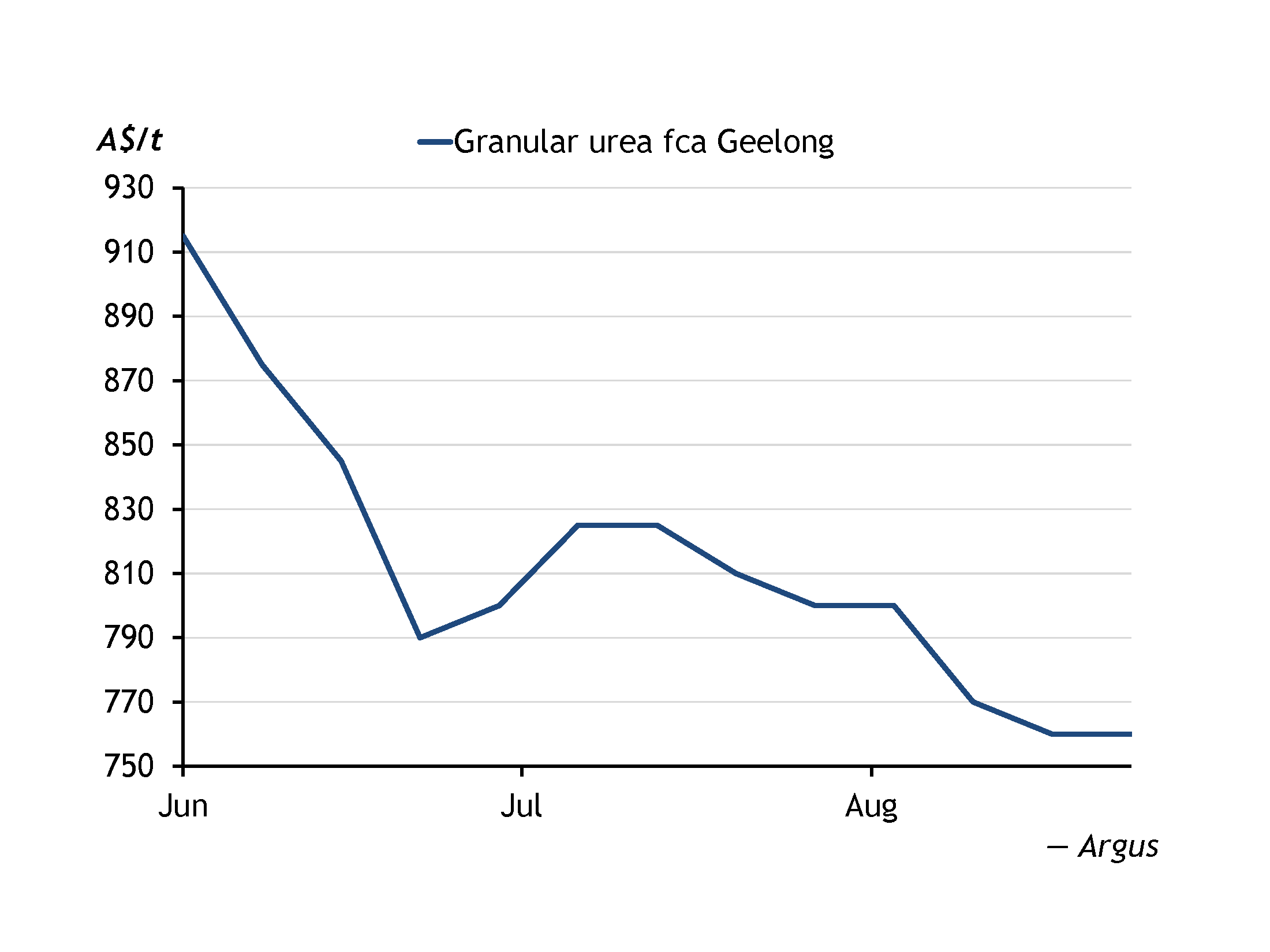
Argus last assessed granular urea at A$750-770/t fca Geelong.
Prompt demand for urea is confined to small amounts for pasture farming and the summer crop, an importer said. Australia’s urea supply is sufficient but the ongoing conflict in the Middle East remains a concern and if not resolved will continue to impact urea prices and supply for the Australian market. Global urea prices are climbing higher but domestic prices are being held steady by slow demand.

Phosphates
Australian grain growers and resellers continue to inquire for early 2027 pick-up of MAP/DAP, and while there is enough supply to meet prompt demand, importers are concerned about availability moving forward. The ongoing conflict in the Middle East, especially in the Red Sea, is worrying Australian importers.
There is product available in the global market, but the import risk has increased in terms of price and timing, Western Australian importer CSBP said in a market update.
MAP/DAP cargoes shipping to Australia normally start loading around November and imports go through to about April. Some discussions are starting earlier this year with the market preparing for supply tightness.
Fertiliser commentary and pricing supplied by Argus Media
Disclaimer: The information provided in this report is general in nature and is intended for informational purposes only.