GrainGrowers Market Update
Shipping routes tighten
Global shipping routes are facing renewed pressure. Conflicts have already disrupted key shipping corridors this year, and adverse weather is now affecting others. Low water levels on the Danube River are constraining Eastern European and alternative Black Sea exports, while the Panama Canal Authority has warned of further reductions in vessel transits because of low rainfall linked to the current El Niño. Some reports indicate Panama Canal traffic has already fallen from 36 vessels a day to 32. If these constraints persist, the global sea freight network will come under increasing strain.
National winter crop rises
ABARES has lifted its national winter crop forecast by 11.9% to 61 million tonnes, up from 54.5 million tonnes in June. If realised, it would be Australia’s fourth-largest winter crop on record, though still 12% below last year’s large harvest. The upgrade reflects favourable winter conditions across Victoria, South Australia, southern New South Wales and Western Australia.
In contrast, ABARES has cut its summer grain forecast from 4.4 million tonnes to 3.4 million tonnes, with El Niño expected to reduce soil moisture through spring and early summer, leading growers to reduce their planting area.
Canadian canola breaks record
The USDA’s August WASDE lifted Canadian canola production by 0.5 million tonnes to a record 22.5 million tonnes, supported by a rise in seeded area from 8.7 million hectares to 9.4 million hectares. Despite the bigger crop, Canada is expected to export less canola than last year as expanded domestic crush capacity absorbs more supply.
Canola prices remain relatively high despite stronger production prospects in Canada and Western Australia. Bloomberg data shows prices hit a year-to-date high of C$841.90/t on 1 September and are currently around C$834.20/t, near their highest level since July 2023. Support is coming from stronger oil prices which flows into biofuel-linked demand and lower EU production.
Wheat market optimistic about Black Sea
Wheat has followed a similar path. Prices reached a year-to-date high of US782.5¢/bu on 1 September, the strongest level since February 2023, before easing to around US728¢/bu.
Earlier optimism around a potential peace agreement which would prevent attacks on agricultural cargo raising expectations of improved Black Sea flows, pulling wheat prices lower. No pact has been reached, and ongoing disruption could create further opportunities for Australian wheat in global markets.
Rates impact interest and exchange rate
Domestically, markets and Australian banks are increasingly pricing in an RBA rate rise on 29 September. For growers, the risk is twofold. Higher rates would lift financing costs, already one of the largest expenses for Australian cropping farms.
Rate expectations are also supporting the Australian dollar, now trading at 72.32 US cents, its highest level since May 2022, excluding May 2026. A stronger dollar reduces the local value of global commodity prices, adding pressure to grower returns.
Oil kicks again
Oil is increasing in the lead up to harvest, unfortunately adding to producers’ costs at a time of higher on farm demand. Brent crude broke through US$100/barrel on 9 September and is trading around US$101.36/barrel, its highest level since 22 May. West Texas Intermediate (WTI) is also stronger at around US$96.60/barrel, near its highest since May. The stronger Australian dollar offers some respite. However, oil prices remain elevated and volatile, with little sign of relief as escalating conflict increasingly threatens commercial oil tankers.
The USDA’s next WASDE report is due on 11 September, after this update was prepared. Its wheat and oilseed forecasts will be key indicators for global supply and demand and may impact price movements.
GIWA will release its September WA grain production forecast next week, on 18 September.
Argus Media Fertiliser Report
Urea
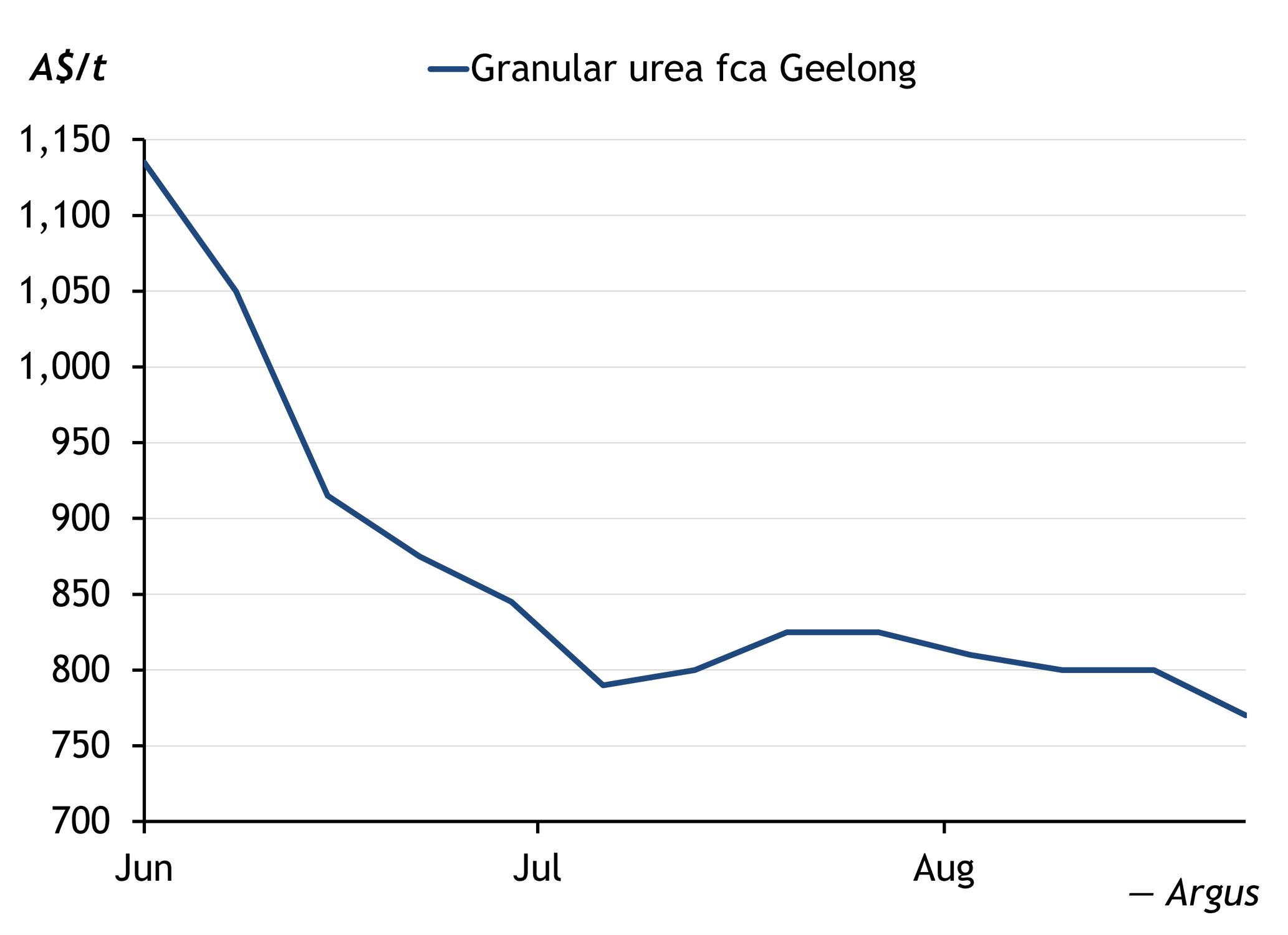
Prompt buying for granular urea remains slow but demand for early 2027 pickup continues to increase on Australia’s east coast.
Argus last assessed granular urea at A$760-780/t fca Geelong.
There are four vessels carrying 107,000t of urea in transit to Australia’s east coast, vessel tracing data from Kpler show.
Australia’s urea imports dropped by 23pc on the year to 240,800t in July, with southeast Asian, Omani and Nigerian product offsetting reduced tonnes from the United Arab Emirates, Qatar and Bahrain, trade data from the Australia Bureau of Statistics (ABS) show.

Phosphates
Australian buyers are hoping to secure both urea and phosphate tonnes early for 2027 pickup because of the ongoing uncertainty in the market as the US-Iran war continues, suppliers said. This is less commonplace for phosphates and last year imports were delayed because of late domestic demand and importers waiting for strong buying signals to secure vessels.
Australia's MAP imports in January-July fell by 16pc on the year to 859,000t, although July arrivals surged from a year earlier on higher shipments from Saudi Arabia, ABS data show.
Australia's MAP imports rose to 25,400t in July from just 1,500t a year earlier. Saudi Arabia supplied 25,000t of the total, while imports from China fell to only 144t from 1,461t a year earlier.
Fertiliser commentary and pricing supplied by Argus Media
Disclaimer: The information provided in this report is general in nature and is intended for informational purposes only.