GrainGrowers Market Update
Wheat prices drop on renewed hopes of a Russia/ Ukraine peace deal.
As of 22 October, the Chicago Board of Trade (CBOT) wheat futures are at 628.25 USd/bushel—down 8.5% over the past fortnight and 19.9% from the late-August high of 784 USd/bushel. Wheat prices are now at their lowest level since 9 July.
The decline reflects recent developments in Russia–Ukraine relations. Both countries met with US officials which has raised hopes of a ceasefire that would end attacks on bulk commodity infrastructure and vessels, allowing wheat exports from the Black Sea region to resume. This followed a proposal by India, Türkiye and India to create a safe Black Sea shipping corridor for grain vessels.
Canola prices also respond to Black Sea politics
Despite a rain-delayed Canadian harvest reducing global production slightly, canola prices have dipped. They are now at 785.5 CAD/tonne, their lowest since 24 August, having fallen 4.7% in the past week.
As with wheat, hopes of a Russia–Ukraine ceasefire is weighing on canola prices, as such an event would see Black Sea exports re-enter the market. Interestingly, in a break from recent patterns, higher oil prices are not translating to higher canola prices.
GIWA increases WA crop forecast 4% to nearly 24 million tonnes as harvest kicks off
GIWA’s October crop report lifted forecast WA production by 870,000 tonnes to 23.9 million tonnes. Oat, barley and wheat forecasts rose 2%, 3% and 9%, respectively, with wheat benefiting from recent mild temperatures.
Canola production was cut 3.7% to 4.6 million tonnes due to limited spring rainfall. Lower forecast domestic production has provided little price support.
South Australia expected to harvest first lentil crop over 1million tonnes
As harvest kicks off in South Australia, it is forecast that the state will produce its largest lentil harvest – exceeding 1million tonnes for the first time ever. SA Departmental forecasts are expecting 1,121,285 tonnes of lentil production, driven by the Yorke and Eyre Peninsula.
Fuel prices reached second highest level since May, but Russian oil shipments are expected to bring prices down
Last week, West Texas Intermediate (WTI) oil prices surged above $100USD/barrel – the second highest level since mid-May. Oil prices have been responding to an escalation in fighting in the Middle East, especially in Saudi Arabia where strikes on ARAMCO oil sites occurred.
Currently WTI prices are sitting at 97.15 USD/barrel—up 8.87 USD/barrel, or 10%, over the past fortnight. However, prices have fallen 6.3% since last week as shipments of Russian oil destined for the US are expected to begin as early as this week, following a winding back of sanctions earlier this month.
Locally, higher global oil prices are flowing on to regional diesel bowsers, but at a slower rate.
AIP reported an average regional diesel price of 282.2c/L this week—up 8.4c/L, or 3.1%, over the past month, but slightly below the 86.1 c/L recorded at the start of the month.
It remains unclear whether last week’s spike in global oil prices will flow to regional bowsers in the coming weeks. Any fuel-price relief would be welcome as harvest gets into full swing.
Argus Media Fertiliser Report
Urea
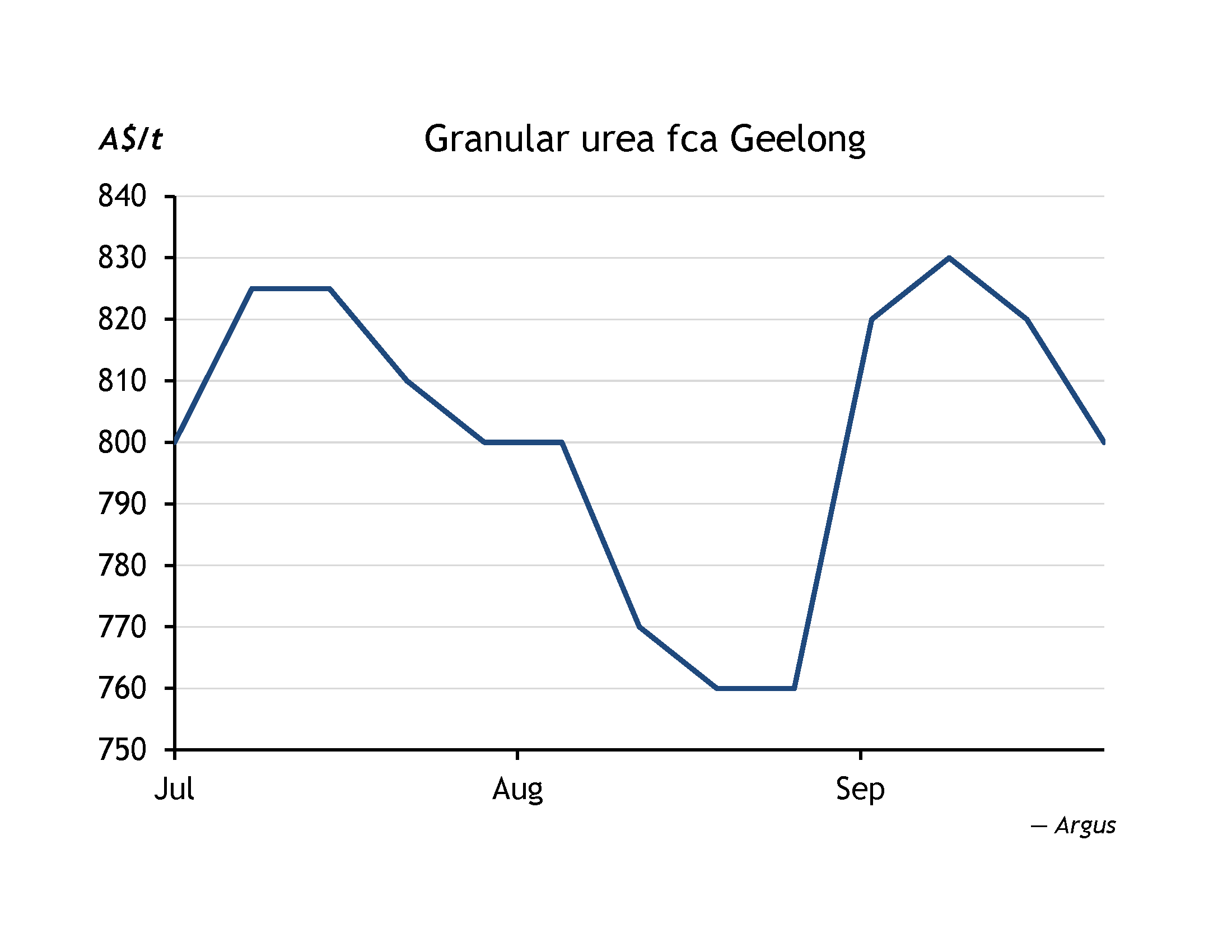
Australian grain growers and resellers remain largely out of the spot granular urea market and are focused on the winter crop harvest that is starting now and will continue through to December.
Argus last assessed granular urea at A$790-810/t fca Geelong, reflecting lowering global prices and a lack of demand.
Growers are focused on harvest, and importers are watching to see the fallout from India’s latest buy tender resulting in a lull in the market.
There are three vessels carrying 125,000t of urea to Australia, vessel tracking data from Kpler show.

Phosphates
Many domestic resellers and growers remain cautious when taking positions after being left with high priced urea in a rapidly falling market earlier this year, which is now driving MAP/DAP buying decisions.
Grain growers are also observing softening global MAP/DAP prices and considering postponing purchases in the hopes of buying lower priced product.
There are no vessels in transit to Australia with MAP/DAP, Kpler data show, but Argus understands that cargos are being organised with major suppliers. Falcon Ichiban was Australia’s latest MAP/DAP vessel, arriving in late August from Morocco, Kpler data show.
Fertiliser commentary and pricing supplied by Argus Media
Disclaimer: The information provided in this report is general in nature and is intended for informational purposes only.