GrainGrowers Market Update
Fuel prices ease on G7 news
West Texas Intermediate (WTI) oil fell 4.9% this week to US$88.28/barrel, its first move below US$90/barrel since 31 August. Prices eased following the G7’s commitment last weekend to release 100 million barrels of diesel from strategic reserves over the next four months.
Singapore gasoil, a better indicator of Australian diesel prices, has fallen 7.9% since the start of the month to US$162.66/barrel. The decline provides slight relief for Australian grain growers as harvest begins
Uncharacteristically, a rate rise has not lifted the exchange rate
The Reserve Bank of Australia raised the cash rate 0.25% to 4.60% at its 29 September meeting—the highest level in 15 years. Higher interest rates would usually lift the Australian dollar by widening the interest rate differential with other countries. However, other central banks are also raising rates, and markets had already anticipated the RBA’s decision.
The Australian dollar is now trading at US$0.69, down 3.6% this month from US$0.72. A weaker dollar makes Australian grain more competitive internationally and increases Australian commodity prices.
Wheat prices reflect hopes of a Türkiye brokered Black Sea truce
CBOT wheat futures are trading at 686USd/bushel, down 2.9% over the past fortnight from 707USd/bushel. Türkiye’s efforts to broker an agreement between Ukraine and Russia to restore Black Sea grain shipments have helped ease prices. However, renewed fighting has tempered optimism about a deal.
Trade routes and export partners are changing the longer the Black Sea conflict persists
Disruptions to Black Sea exports are reshaping trade flows. France exported wheat to Sudan for the first time in 18 years as the African market sought alternatives to Black Sea supplies. Türkiye and the UAE are looking to the Baltic states to replace Russian shipments, while Bangladesh is seeking supplies from India.
Although India’s wheat stocks are currently sufficient to allow export restrictions to be lifted, its driest monsoon in 11 years has reduced reservoir levels needed for irrigation. Combined with the expected effects of El Niño, this is expected to reduce India’s wheat harvest next season.
Oats prices continue to climb reaching the highest level all year
Oat futures have reached their highest level this year at 428.75 USd/bushel, up 49% from a year ago. Prices have been supported by drought-related reductions in harvest volumes and yields in the UK and Europe, and less area planted in Canada as Canadian growers chased higher return crops. The EU and Canada are the world’s two largest oat-producing regions.
Canola prices remain stable with strong global demand for oil seeds especially from India
Canola futures are trading at $817.80CAD/tonne, down $24.10CAD/T, or 2.9%, from their early-September annual high of $841.90CAD/tonne.
Russia and Ukraine account for more than half of global sunflower oil production, and India is the largest importer. As conflict slows Black Sea shipments, Indian importers are seeking alternative supplies ahead of the September–November festival season when frying activity lifted. This is supporting demand for canola and other oilseeds, helping sustain prices despite Canada’s large, but delayed harvest.
USDA Report
The USDA’s October World Agricultural Supply and Demand Estimates (WASDE) report is due today, updating grain production, export and stock forecasts. Any material revisions could move market prices.
Argus Media Fertiliser Report
Urea
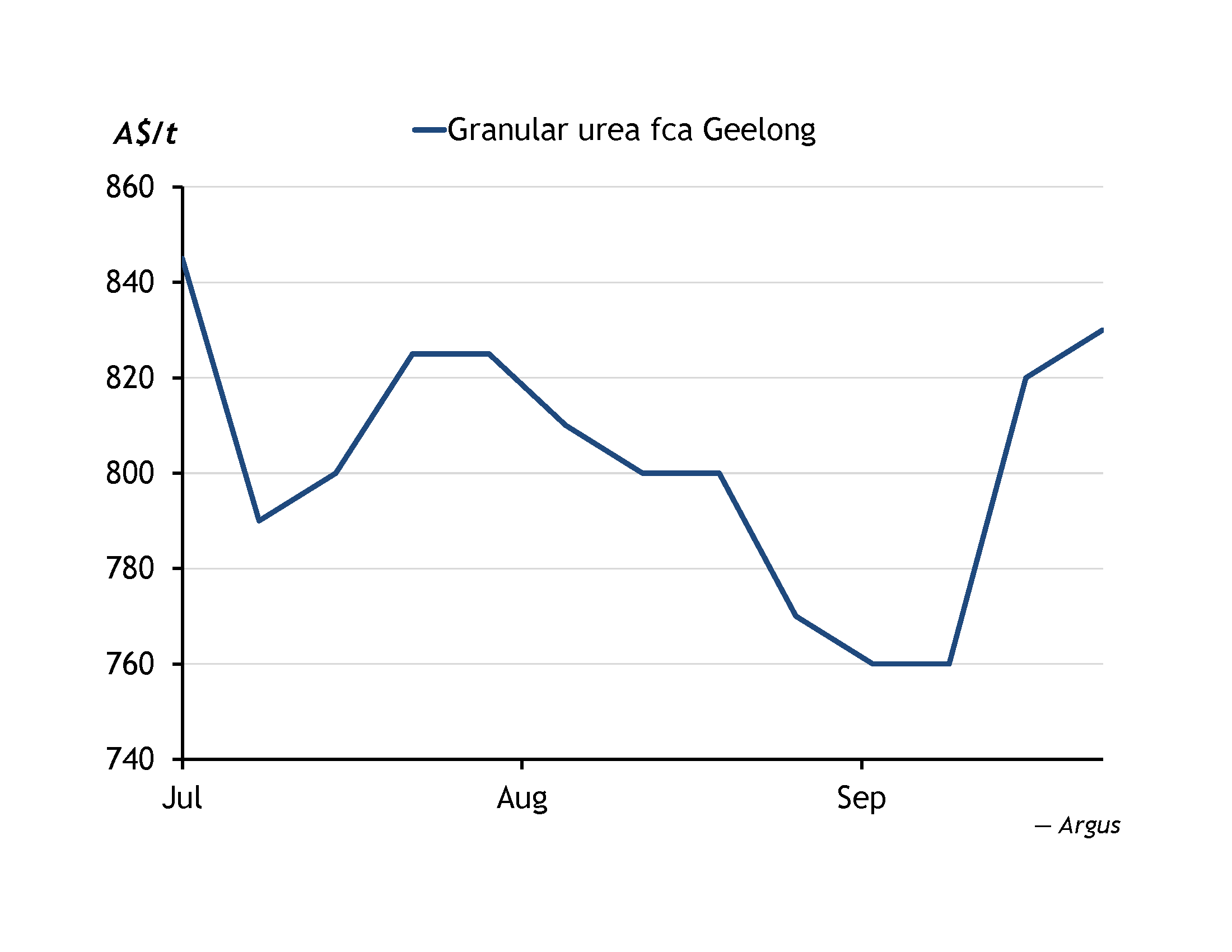
Grain growers and resellers are holding back from significant prompt granular urea buying but enquiries remain strong for December onwards pick-up.
Argus last assessed granular urea at A$820-840/t fca Geelong.
Forward buying enquiries were heard for as late as April, which is very uncommon. The market uncertainty driven by the ongoing Middle East conflict is one of the reasons behind forward buying enquiries. Grain growers in Southeast Queensland and Northern New South Wales are waiting for stronger rainfall to lock in urea for summer crop applications, resulting in slow prompt demand.
Importers remain focused on China and Southeast Asia for further imports because of the proximity to Australia and attractive prices compared to further afield origins.
Replacement fertiliser prices are also being pushed up by the weaking Australian dollar, which reached an 11-week low of US$0.6949 on 1 October.

Phosphates
Australian importers are starting to organize MAP/DAP vessels from Morocco for loading from October to meet continued demand for pick-up from December. Prompt pick-up demand remains slow. Vessels take at least 6 weeks to reach Australia from Morocco’s Jorf Lasfar port, vessel tracking data from Kpler show.
The ongoing conflict in the Middle East is fuelling concerns over phosphate supply and pricing in Australia ahead of the 2027 winter cropping season.
Fertiliser commentary and pricing supplied by Argus Media
Disclaimer: The information provided in this report is general in nature and is intended for informational purposes only.