GrainGrowers Market Update
Oil prices tumble, offering relief during harvest fuel use peak
West Texas Intermediate (WTI) oil prices are currently $83.09USD/barrel, their lowest level since late August—nearly three months. Since the start of October, prices have fallen by more than $21USD/barrel per barrel (20.2%), from $104.12USD/barrel.
Despite the ongoing war, oil prices have fallen on expectations that the mid-term results will hasten peace in the Middle East, alongside rising regional production. Saudi output reportedly rose 26% in October to a multi-year high, similarly Iraq also increased production.
GIWA report forecasts material drop in canola production
The Grain Industry Association of Western Australia (GIWA) cut its 2026 grain production forecast by 615,500 tonnes (3%) to 23.3 million tonnes in its November crop report, released today. The Albany zone accounted for most of the reduction, with its forecast cut by 400,000 tonnes (8%) since October.
Canola recorded the largest downgrade, with production now forecast at 4.1 million tonnes, down 11% from the 4.6 million tonnes reported in October. GIWA attributed the reduction mainly to poor pod development in some varieties, noting the revised forecast reflects substantial volumes already harvested. Wheat production was revised up by 14,000 tonnes to 10.9 million tonnes, and the pulse forecast rose 3.5%.
GIWA had expected combined canola and barley production to exceed wheat production earlier in the season, but the canola downgrade has reversed that outlook.
AUD falls to lowest level since Janaury
The Australian dollar fell to 66.84 USd, its lowest level since January and 5.3% below its late October level of 70.6 USd. The decline comes amid expectations that the US Federal Reserve may raise interest rates in December.
A weaker Australian dollar is helping the competitiveness of Australian grain exports in global markets and supporting domestic grain prices.
Soybeans and oil outweigh China demand and WA crop cuts in canola pricing
Canola is trading at $770.10CAD/tonne, down from $782CAD/tonne earlier in the week and about 2% above the four-month low of $753CAD/tonne on 5 November. Prices have shown little response to the lower Western Australian production forecast or stronger Chinese demand for Canadian canola meal. In September, Canada exported more canola meal to China than to the United States.
Lower crude oil prices continue to weigh on canola, while expectations of lower palm oil production in 2027 have yet to lift prices. Canola has broadly tracked soybean prices, which are under pressure from the US Department of Agriculture’s forecast of a near-record soybean harvest.
Strong Australian and Argentine harvests are capping wheat prices
CBOT wheat futures have traded in a narrow range over the past three weeks, between the high 500s and low 600s USd/bushel. Futures are currently at 584 USd/bushel, down only 1.2% from a fortnight ago.
Australia’s strong harvest and a forecast for Argentina’s second-largest wheat crop on record, at 24.3 million tonnes, are limiting price gains. Hopes for a peace agreement have also helped contain prices, although uncertainty persists in the Black Sea.
Low prices are encouraging import buying, particularly from China and Algeria. China purchased 120,000 tonnes of French wheat, the highest monthly volume in two years.
Quality, protein, and grade are key this harvest.
Summer crops prospects brighten
Queensland experienced its second wettest October since 1900, according to the Bureau of Meteorology. Rainfall for the month was three times the monthly average. This rain has helped improve soil moisture profiles and is expected to lift production forecasts for summer crops.
Coming reports
ALFA and MLA will release their September 2026 Lot Feeding Brief this week. The report covers cattle on feed numbers and feedlot capacity across Australia. The report is expected to show another record for cattle on feed, with continued feedlot expansion supporting structural and ongoing demand for Australian feed grain.
Argus Media Fertiliser Report
Urea
Australian grain growers remain focused on the winter crop harvest and are waiting to buy more granular urea.
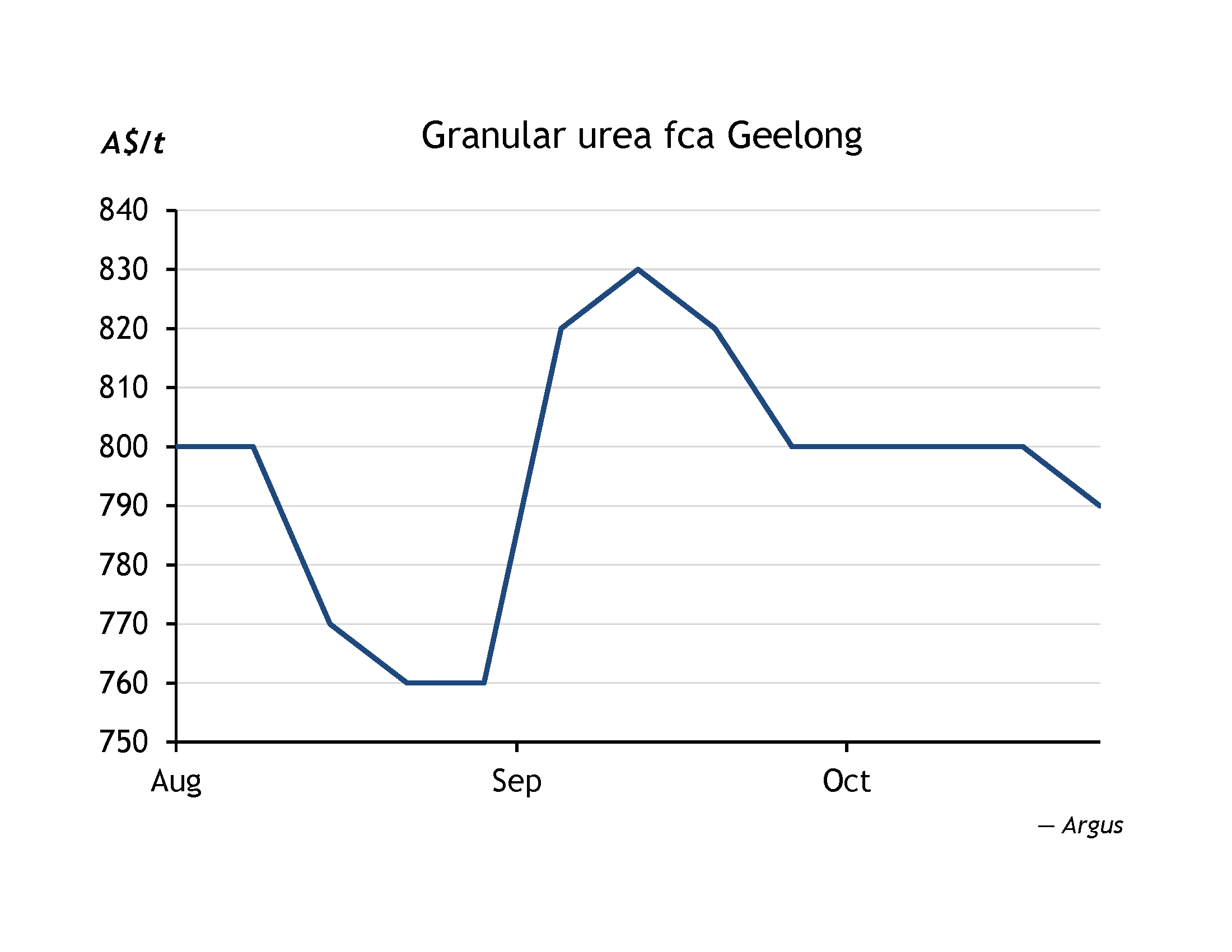
Argus last assessed granular urea at A$780-800/t fca Geelong.
There are three vessels carrying 113,000t of urea in transit to Australia, all from Southeast Asia, vessel tracking data show.
The fertiliser application off-season, coupled with geopolitical uncertainty, is keeping importers on the sideline. Domestic buyers continue to hold back from purchases, with some indicating they may return to the market early next year.
Recent rainfall in the northern grain-growing regions has improved soil moisture profiles but left some regions excessively wet, potentially delaying further nitrogen applications.

Phosphates
Australian buyers and sellers continue to hold back from MAP/DAP purchasing because of low agronomical demand and the expectation of softer global and domestic prices.
Importers are organising some vessels to maintain supply of MAP/DAP but are waiting for further demand indications from grain growers and retailers to secure more significant volumes. Market participants are also happy to wait before securing more tonnes until there is more clarity surrounding trade out of the Middle East because of the slow demand locally.
News
Australian agribusiness Elders' fertiliser sales fell by 2.6pc on the year to 1.07mn t in 2025-26 financial year ended 30 September 2026, while higher urea prices lifted its gross margin on fertiliser sales by 16.7pc, the company said on 16 November.
Fertiliser commentary and pricing supplied by Argus Media
Disclaimer: The information provided in this report is general in nature and is intended for informational purposes only.