
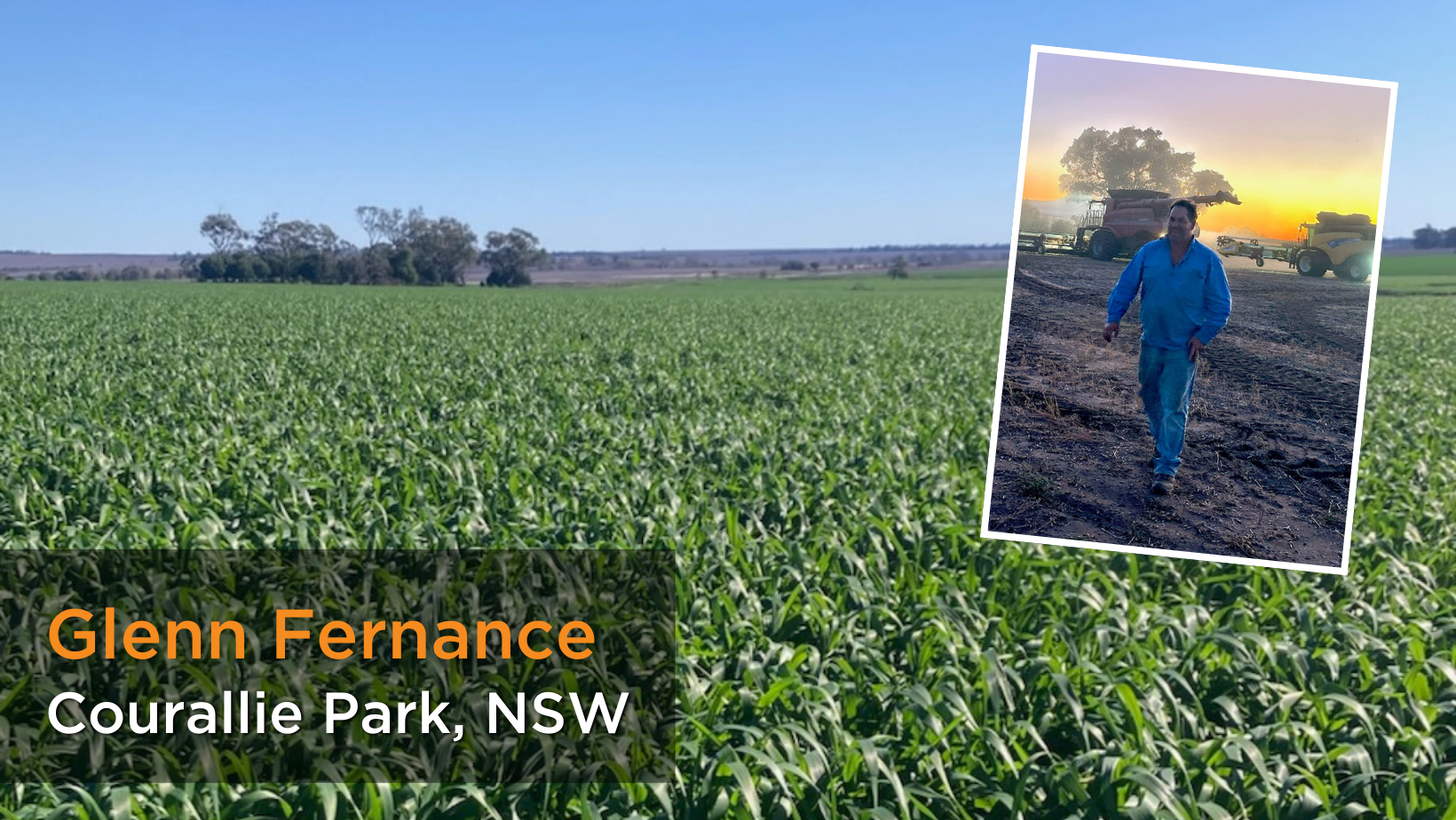
Hi, I’m Glenn Fernance, and we run Courallie Park on country about 30 kilometres east of Bellata, between Morree and Narrabri. The farm (which is really four farms in total) covers both cropping and cattle, with about 3,000 hectares of country growing sorghum, cotton, chickpeas, wheat, barley, and even fava beans at times, and a further 2,000 odd hectares where we run cattle.
On the cropping side of the equation, our rotation is generally wheat, cotton, chickpeas, and sorghum, with planting also depending on when the break is and whether we plant a summer crop. Fava beans are a good rotation crop, but they need to be worth some money, or we tend to steer clear and stick with our normal rotation.
While there is some variation, we mostly crop into self-mulching basalt soils that are generally nice and loose, with plenty of organic matter. Everything is no-till, and we cultivate behind the chickpeas every now and then when there's no cover. The soil handles things fairly well, and straight up after harvest, we generally spray to get things down, and then just camera-spray from that point on. It works for us, and we manage to keep on top of the weeds that way. When we do cultivate, it probably makes things a little harder as the soil tends to wash or blow away. This soil is fairly soft, so without tilling, it can get a bit uneven and rough, forming big ruts. We use controlled traffic lines, so once we level and fill, we go back on the same line, which then compacts fairly hard underneath. Overall, it’s really not too bad.
When it comes to rainfall, there is a bit of variation. The farms we operate are really only the proverbial stone's throw away from each other, but the one farm with a hill range receives 900–1000mm on average, while the others are around 600-750mm. It does make it a bit of a challenge, and the difference is in the summer rainfall, which is mostly patchy and scattered storm activity. This year, we have had some very patchy storm activity, and while we have managed to miss most of the hail, some people locally have been hit pretty hard. To give you an idea of the impact of the weather, on one of our farms we are harvesting around 5.5 t/ha of sorghum, while the farm on the other side will be around 3 t/ha. A lot of the difference in yield I would put down to the storms.
At the moment, what lies ahead is not looking all that wonderful, particularly with the back end of March and April predicted to be dry. We still have that variation across our farms, and while our soil profile is currently from three-quarters to half full, we're probably looking for another 100 to 120mm to fill it.
We have had a beautiful winter season up here, and where there is a lot of heavy stubble on the country, it is looking good. It is only half full, but it’s wet on top, and where it is dry on top with the moisture further down, we are on a bit of a seesaw as to whether we will get those winter crops in on time. The best way to describe it is that we just haven't had the usual summer rain.
The rain, or the moisture levels, really impact the next decisions, because we would want to see a fuller profile before we start throwing urea at it, particularly at the current price for fertiliser. It's really a bit of a catch-22 situation at the moment, with high input costs and lower commodity prices. With soil profiles that are either minimal or half-full, there are potentially costly decisions to be made.
Like most growers, we like to stick to our program as much as we can. But the reality is that at some stage, your business brain has to kick in and you need to prepare for what might come your way.
At the moment, we are pretty much flat out. We are feeding cattle, and we have another week or so to finish the sorghum harvest. After that, we will be camera spraying, getting our planters and tractors serviced, and making sure everything is ready to go for planting.
With the weather the way it is, we are tossing up whether we get into a urea program, so we will have a closer look at the paddocks and delay that a little to see if things change. The good thing is that many of the soil test results will be back by the time we finish the sorghum. At that point, we can take a more informed decision about whether to go ahead or hold back a little. We do have a rulebook that has served us well in terms of timing and rotations, and we generally get things done on time, but sometimes we need to bend the rules a little to achieve the best possible outcomes.
Among our big challenges, I would nominate workforce issues as significant for us. It is a challenge just about every day to work out what you need to do in terms of labour. The cost of machinery is also out of control. We keep track of what we are going to replace, and we keep our tractors fairly much under warranty, but you can’t do that with all your gear, so we try to be a little selective.
Looking ahead, I have a son who is keen to return to the farm at some stage. If that happens, I think we would look closely at opportunities to expand our operation in the future. While he is off playing football at the moment, he is fairly switched on to the farm, which should make the transition easier. The great thing is that he has been encouraged to look around and see what we can do better, and I am happy to listen to and see where improvements can be made, so I am looking forward to the possibilities.
We were recently named the NSW winner of the AgShows NSW/Suncorp Bank dryland wheat competition for 2025, so I guess we must be currently doing something right! I have been involved in these competitions since I first started cropping, and there are some very good farmers around me, one in particular who was consistent, and I took the time to talk to him and learn as much as I could. We go fairly well, have been finalists in the past, and previously won the NSW Durum Wheat competition. It is a great way to benchmark how we are doing compared to the rest of the state and to get an idea of whether we are doing as well as we can. I always encourage people to get involved, talk to others, and take home some ideas to try to improve their own cropping operations.
At the end of the day, I enjoy growing good crops, and while it is a challenge at times, I love what I do.