
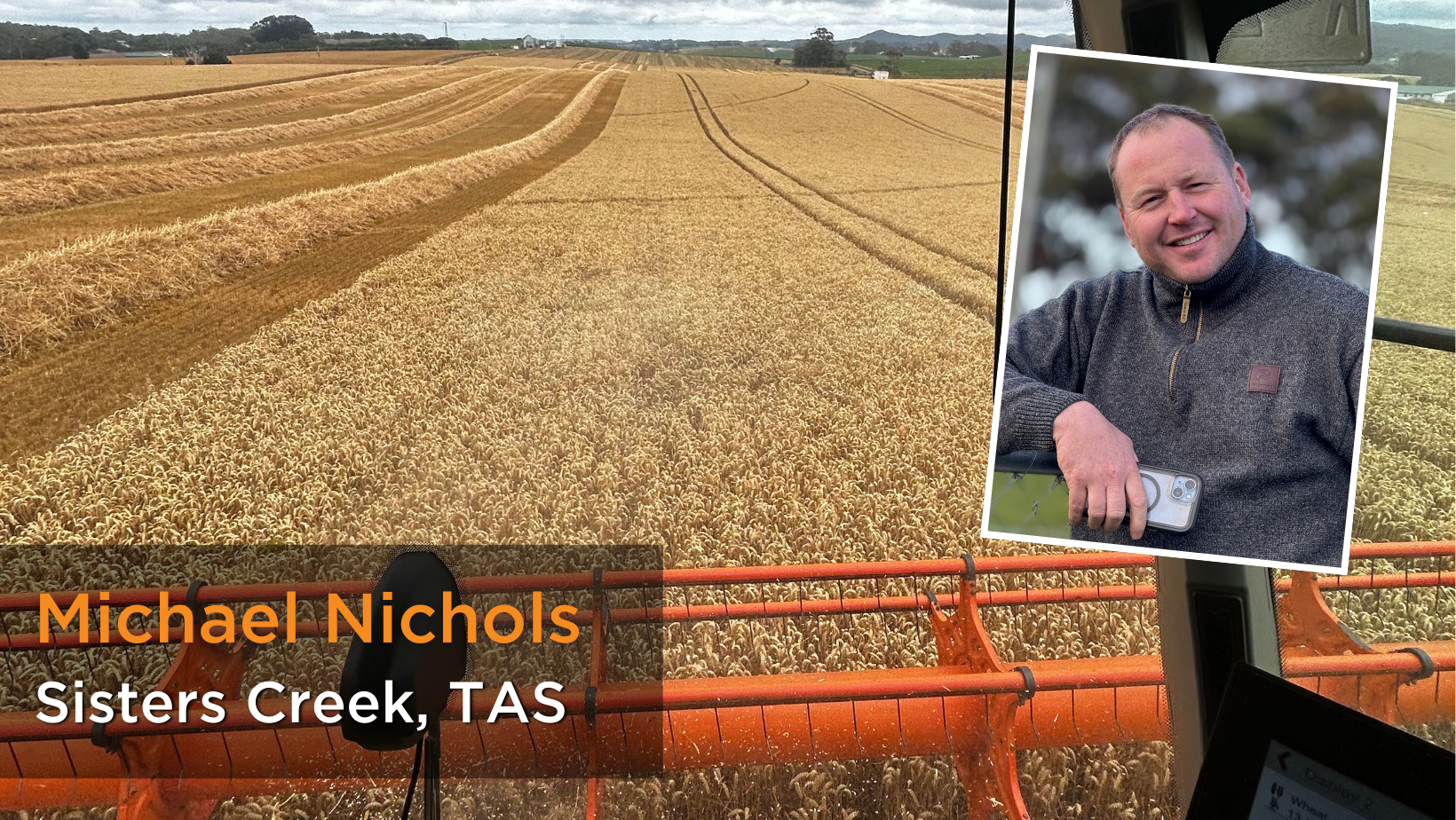
Hi, my name is Michael Nichols, and I farm with my wife Rochelle and our six kids. The younger ones are in primary school and the older boys are either at high school or working in Burnie or Launceston, which is about two hours’ drive east. Rochelle handles the bookwork and does more driving than most people would believe, keeping everything moving between school, farm, sport and life.
Most of our place backs straight into the bush, so the farm feels tucked in between the forest and the coast. We farm along the north west cape of Tasmania, in a pocket of the island that sits between the rugged coastline and the national park country behind us. If you head east, you hit Wynyard and Somerset; if you head west, you’re at Rocky Cape.
We run a mixed operation: wheat, barley, canola, corn, potatoes, onions, mustard seed and poppies, plus a small beef herd. One thing people often don’t realise is that almost every paddock has irrigation. That’s because we’re in a vegetable driven district — most cereals follow potatoes or onions, and those crops require irrigation infrastructure from day one, so the gear is already in place when wheat or barley goes in behind them. We get roughly 1000–1200 mm of rain, but almost all of it falls in winter, not when crops actually need it.
Cereals are our opportunity crop. They’re lower input than vegetables but still perform extremely well. Most years we’re harvesting 10 to 13 tonnes per hectare, and this season one paddock averaged 13.5 tonnes.
Our machinery setup suits the terrain. Field bins don’t suit paddocks this small or steep, so we use tandem trucks to keep grain moving efficiently. My header is a CLAAS combine on tracks, under 3.5 metres wide, so I can travel without an escort and stay stable across slopes. During harvest, I might make five paddock moves in a day, taking the front on and off to get through narrow gateways. And when coastal rain pushes in — even briefly — it can shut us down for the day. I’m also the contract harvester for the 12 other growers in our grain group, NW Grain Pool, which makes for some big days when the conditions line up.

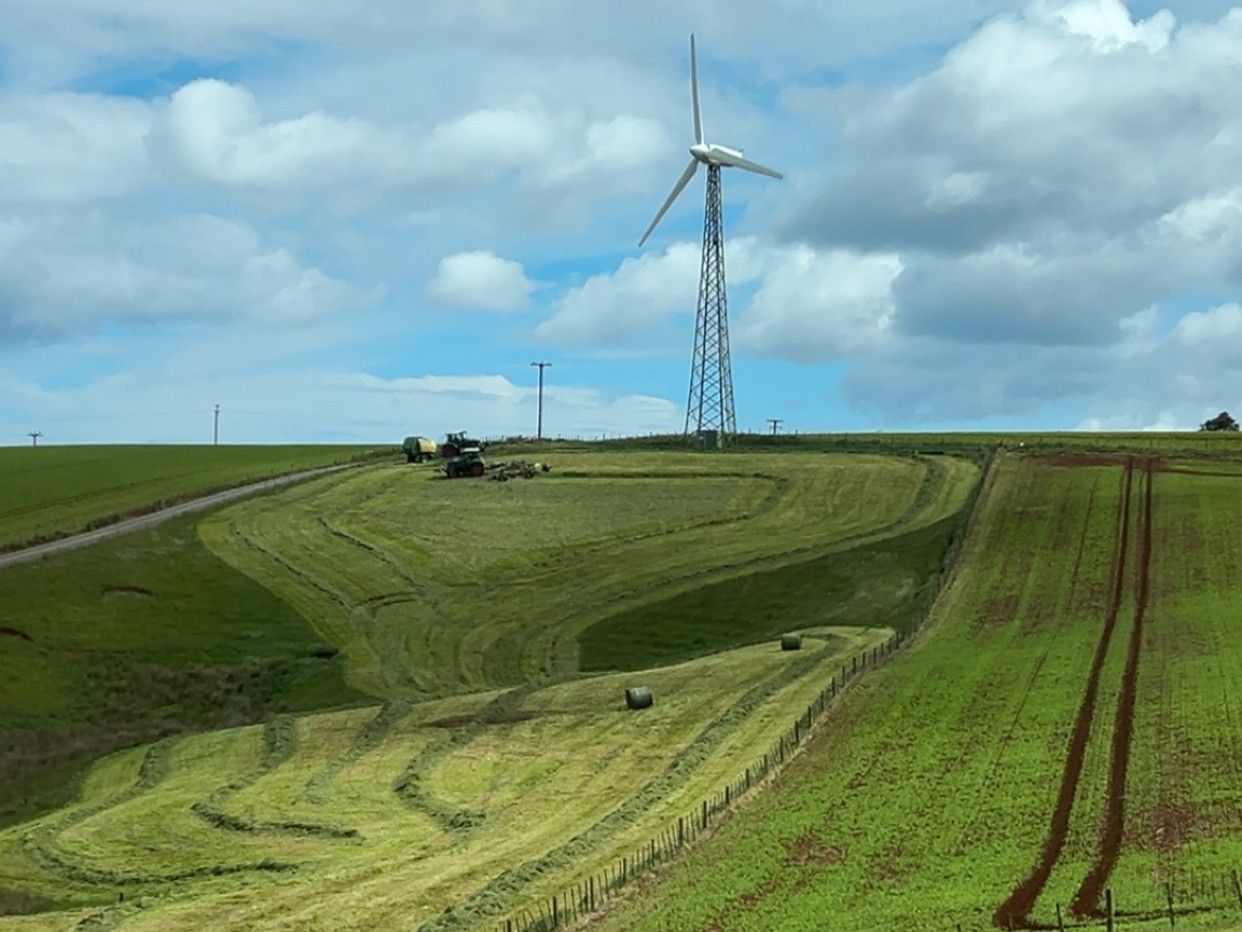
Workforce is a challenge in this district, like it is in most regional areas. We’re lucky to have two long term employees — one with us for twelve years, the other for seven — who know the country and the gear. The variety across our farm helps with retention too. There’s always something happening — grain, veg, poppies, cattle, harvesting, drying — so no one ever gets bored.
Tasmania’s potato industry is a major driver in our region. We supply into the two big processors: Simplot Ulverstone, and McCain’s Smithton plant both of which have upgraded their production facilities to support increasing capacity. Those processors are why potatoes remain such a reliable part of our rotation.
Ten years ago, after completing the GrainGrowers Australian Grain Leaders Program (AGLP), I founded NW Grain Pool — our region’s open book grain pool. Before we started, our little patch around Sisters Creek was producing about 1,000 tonnes of wheat from roughly 120 hectares each year. Today, that figure has more than tripled to around 3,500 tonnes, all grown in this small district, and the growth has come directly through the cooperative system we’ve built.
The idea was simple: we had strong yields but no coordinated pathway to market. Too many small loads, too many logistics challenges, and not enough certainty for either growers or buyers. I’d met a lot of broadacre growers on the mainland during AGLP, and it opened my eyes to how coordinated grain marketing could work at scale. I realised we could do something similar here, just adapted to our terrain and size, and that became NW Grain Pool.
Today, we store, manage and market the grain for 12 growers from Somerset to Rocky Cape. We sell directly to five dairy farms in the region, who want reliable feed grown by locals. It’s a win win: dairy farmers get consistency from one seller, and growers get guaranteed access to market.
At the end of harvest, we calculate the total grain in storage, and everyone is paid proportionally across the year based on their share. It’s simple, transparent and steady.

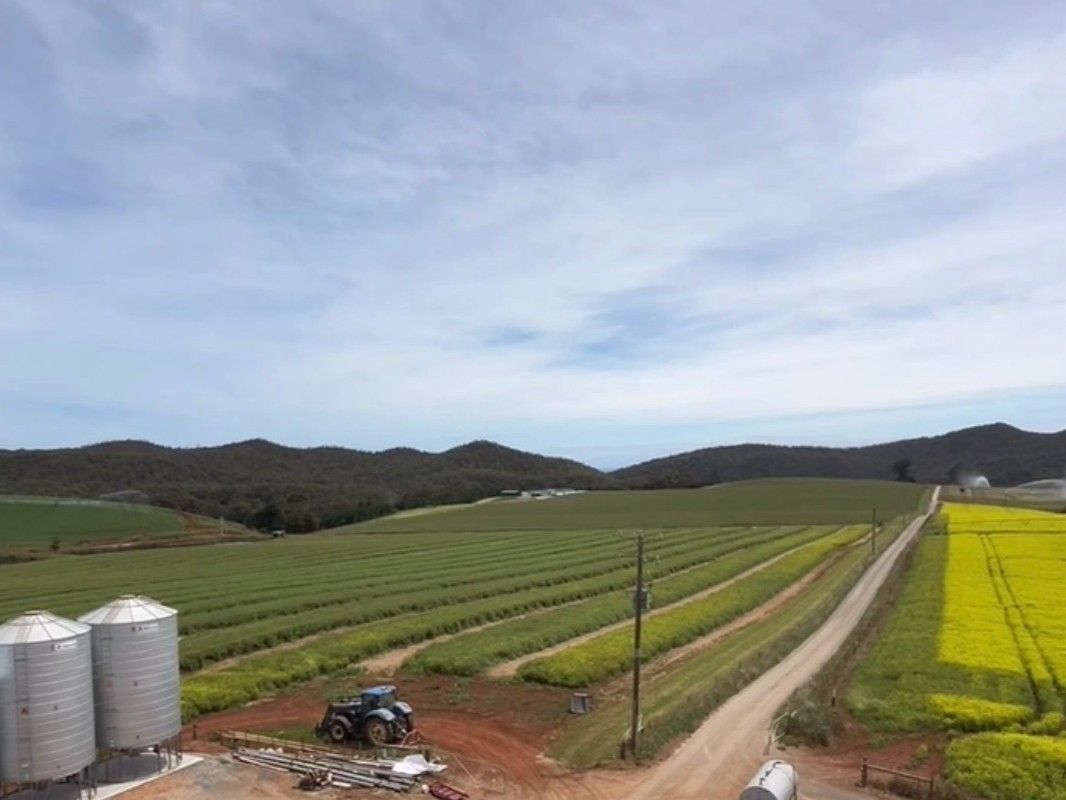
We also press a small amount of cold pressed canola oil on farm — around 30 to 40 tonnes a year — mostly for Hillfarm Preserves, which Mum founded years ago, and North Bay Seafoods, who use our oil to store mussels. Cold pressing retains the omega rich fatty acids that fish farms increasingly look for as they shift toward plant based feed sources. Alongside that, we grow yellow mustard seed for the Japanese whole seed market.
Poppies are another major crop for us. Tasmania produces around 60% of the world’s legal poppy alkaloids, and I currently serve as President of the Tasmanian Poppy Growers. It’s a strict, well regulated industry — licensed paddocks, police checks, full traceability — but it’s something the state has been refining for decades.
Caring for the land is something our family takes seriously. Dad won the 2005 National Landcare Award for Primary Production and Environmental Works, and in 2021, Rochelle and I received the Australian Government Land Management Award for our soil testing, variable rate nutrition, liming, cover cropping and biodiversity work. We’ve fenced off fragile country, created wetlands and built habitat for lacewings, hoverflies, ladybirds and other beneficial species.
Like most landholders around here, wallabies are one of our biggest pressures. They’re constant across the landscape and hard on both crops and regenerating bush. Installing wallaby exclusion fencing has made a huge difference and once the pressure drops, paddocks establish cleanly and native vegetation bounces back.
Beyond the farm, I stay involved wherever I can. I’m an active member of Southern Farming Systems, which is valuable for trials, agronomy insights and networking — especially for Tassie growers, who don’t always get the same access to mainland data. I’ve also been with the Boat Harbour Tasmanian Fire Service for more than twenty years and now serve as Second Officer. Community here relies on people showing up, whether it’s a fire, a storm or a neighbour needing help.
People sometimes assume small paddocks mean small capability, but our district has held national records in wheat, barley and canola. Some days I’ll be harvesting on Table Cape, looking straight out across Bass Strait with a 200 metre drop in front of the header, and it reminds me exactly how unique this landscape is and how much it shapes the way we farm it.
What makes me proud to be a Tasmanian grain grower is simple: producing some of the highest performing crops in the country and showing that scale has nothing to do with capability. We farm on the edge of the world — literally — but that edge keeps us sharp. And I reckon we’re better for it.