
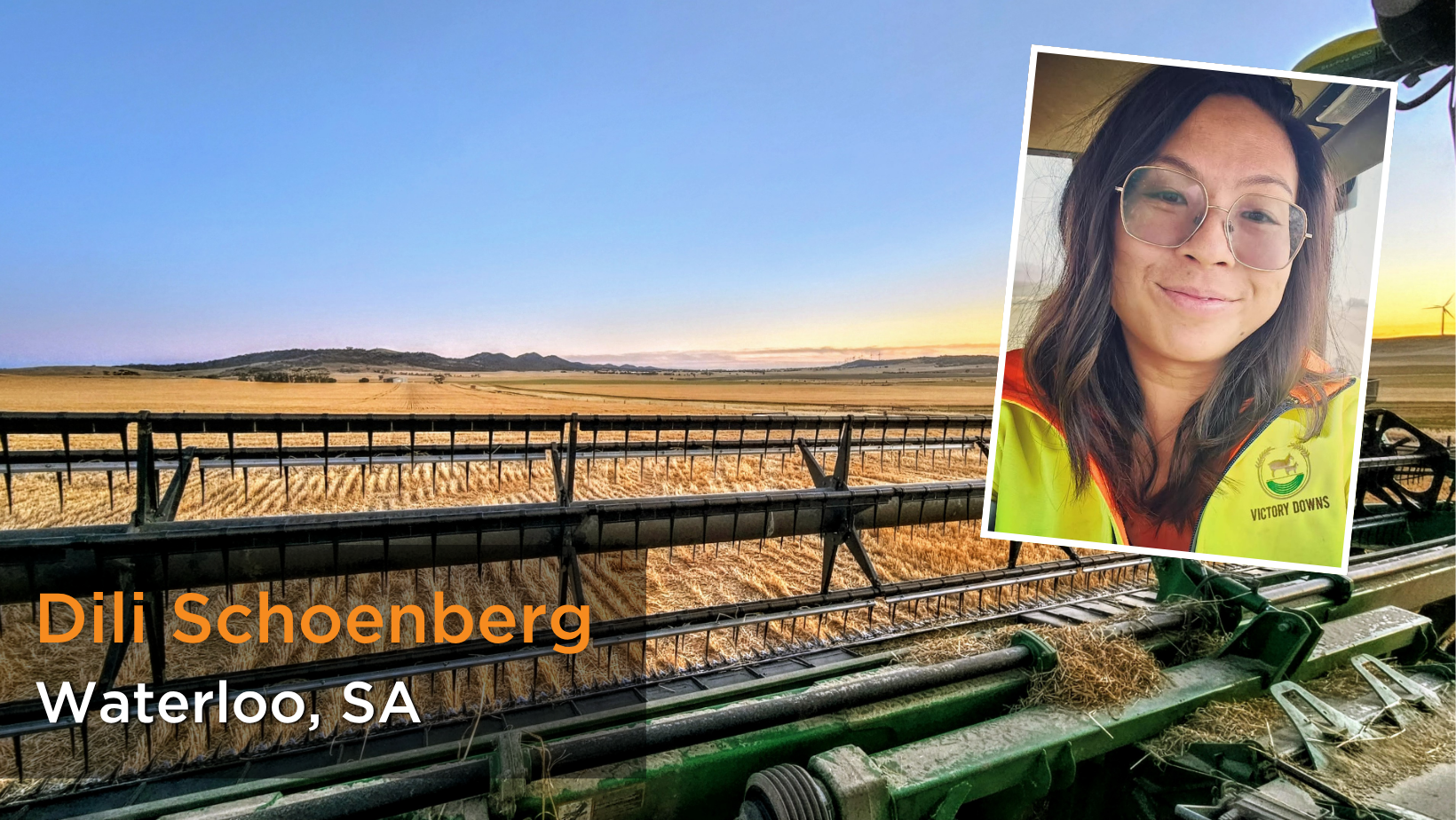
My name is Dili Schoenberg, and I am pleased to tell you a little about myself and our family's farming operations.
Our farm at Waterloo is basically halfway between The Barossa and the Clare Valley, so we have a choice of driving half an hour to Clare or forty minutes to Barossa to access services. Our children Duke and Delila attend a small 30-person school at Manoora, which services the local towns of Manoora, Waterloo and Blacksprings. Like a lot of country towns, we have a big community-driven sports club, and we recently got some upgrades to our sports complex. With those upgrades came a fitness centre complete with a 24/7 gym. We don’t have a café or a public library, but we do have a post office that uniquely operates out of our local seed cleaning business. I grew up in Sydney, so living on a farm with neighbours kilometres away has been a huge change. I have been so lucky to land in a small town community filled with the most supportive and amazing people, including my own family. I really think that is the most special part of rural living that needs to be protected.
We run a typical family operation, with my husband, Daniel Schoenberg being the third generation on the farm. His father, Vic, who is 81, has seen many changes over the years, and he is still actively involved in our daily operations, which at the moment is soil preparation for seeding. Initially, the property was used for mixed farming, but we have switched to where we now have around 1,200 hectares of cropping, including 500 hectares that we share farm.
In terms of my background, I come from a science pathway that has led me to the farm. The direction goes back to my uncle, who was a soil scientist with the United Nations. I grew up hearing of his travels from all over the world looking at soil health. As a child, I was inspired by the science of understanding how things work, and loved the opportunity that a role in science could provide in terms of a global connection.
Ultimately, I ended up in agricultural science, because although I love science it is the application part that really appeals to me. I was fortunate enough to work with the South Australian Research and Development Institute (SARDI), working with some great scientists on some amazing groundbreaking, innovative programs and projects, and I love being able to use some of my science background on the ground in our farming operations.
We mostly crop on red, acidic soil, and we are continually trying to improve soil health. We do our own testing and map the paddocks so we know where to apply the lime and nitrogen inputs. Talking to my father-in-law, the changes to cropping systems he has seen in this area over the last eight decades have been phenomenal, with a lot due to a mix of soil improvements as well as changes to crop variety and agronomy practice. From a water-use perspective, we have had some well below average rainfall — and in fact the lowest rainfall on record in 2024 — and some of the yields we achieved are remarkable given how little rainfall was received.

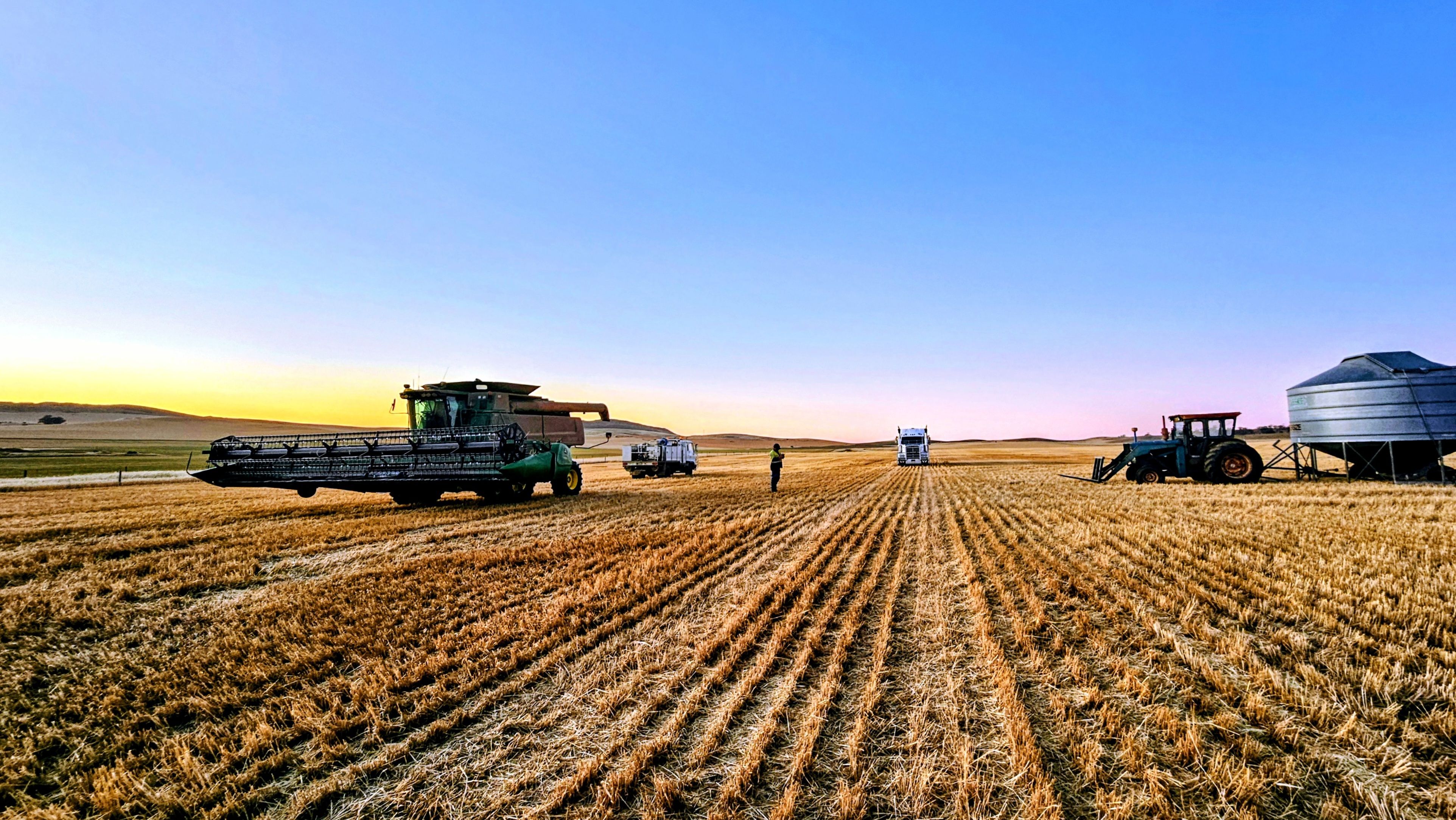
Things are looking pretty good right now, as we have had quite a bit of rain over the summer and everything has greened up beautifully. As a result, there's a lot of spraying going on, but it's nice to know the subsoil moisture is there ahead of seeding. We have been nearly 100% dry sowing since the 2023/24 drought, so these early rains have really taken the pressure off for a lot of our area. Our average rainfall is typically between 400-450mm at Waterloo.
With acidic and occasionally dispersive soils, applications of lime and gypsum have been instrumental in improving soil health over the past 20–30 years. More recently, the use of chicken manure has helped increase biological activity and build soil carbon. Together, these practices are contributing to improved pH, soil structure and water holding capacity. We are also always looking at ways we can improve long-term sustainability. For example, where heavy stubbles were once burnt, we now speed till residues back into the soil to rebuild carbon. Our aim is to address our two biggest risks — frost and drought — by improving soil health metrics such as water holding capacity, which in turn helps with buffering ground temperatures. As with all family farms, our goal is to keep the farm and the business sustainable for the next generation.
We aren’t the first ones in this area to adopt a lot of these changes, but it’s so important to look at how we can continually refine our systems and meet those long-term goals. I’ve learnt that farming is firstly about managing risks, and secondly about capitalising on opportunity (like when it rains!).
The other area where we see opportunity is in agtech. Daniel is particularly into the technology side and enjoys “all the toys”, like using drones for aerial mapping to improve our efficiencies on farm. There’s a lot happening in this space, so investment needs to be carefully assessed to ensure it fits the operation and delivers value. I enjoy working with the data, while Daniel enjoys the tech and together, it works well for us. Despite the amount of data we have on farm, it can be hard to quantify compared to a research trial, but we were seeing improvements especially when we look at the 2024 drought, where we had the lowest rainfall in a 24-month period on record, and still got some paddocks producing 5 tonnes. We also had some produce nothing, and I think there is so much opportunity to learn more in this space.
Currently, the soil testing process is a bit of a constraint – physically going out to take samples and sending them off for analysis. It’s laborious, time-consuming and expensive. Whether it is satellite or drone mapping, there is interesting work being done, and it’s exciting from a data perspective to see how quickly this space is evolving. We don’t have access to a hyperspectral camera yet (way too expensive), but I think the future will be in remote sensing, allowing us to look more closely at soil and plant constraints and consider ways to raise the average of a paddock to a uniform high.
While our soil improvements have been ongoing, in recent years we have also started to look towards introducing other sustainable practices, such as intercropping or mixed-species cropping. This approach works best when it is either a pulse, pulse combination or a pulse, oilseed combination. It doesn't work when you're going from a dicot to a monocot, from your cereals to your broad leaves, as when you use selective herbicides, you select for either monocots or dicots. Essentially, you can take your cereals out of your broadleaf crops, and your broadleaf crops out of cereal crops, but once you start mixing those, it doesn't work that well.
We have sown canola with vetch and lentil and faba bean. A lot of people have grown lentils and faba beans because they want to incorporate lentils into their program, from an economic point of view, to produce a higher-value crop. It’s probably most useful when you are trying to get a higher value crop into your rotation, but don’t have the confidence to do it as a sole crop.
Using lentil and faba bean as an example, you might – depending on your area sow them both at 60% each, so you have more plants overall. If the season is on the high rainfall side, you know the lentils don’t like it, so they will fizzle out, and the faba beans will grow more abundantly. However, in a dry year, you might get a bigger lentil yield; the crop adjusts to the season. If you look at a ten-year period, the idea is that it will self-adjust and average out to provide an economic buffer for the seasonal variation.
It still needs to be done in rotation, and we carefully review all the different rotations and how they integrate to manage our risk. It is all about looking forward, planning to see the risks and opportunities and trying to have as much information as we can, to help make the right decisions. As growers, we have so many different moving parts in the business and having a good team of experts you can call on makes a huge difference. We have an amazing agronomist, accountant, and lawyers who have expert knowledge we don’t have, and that can make all the difference.

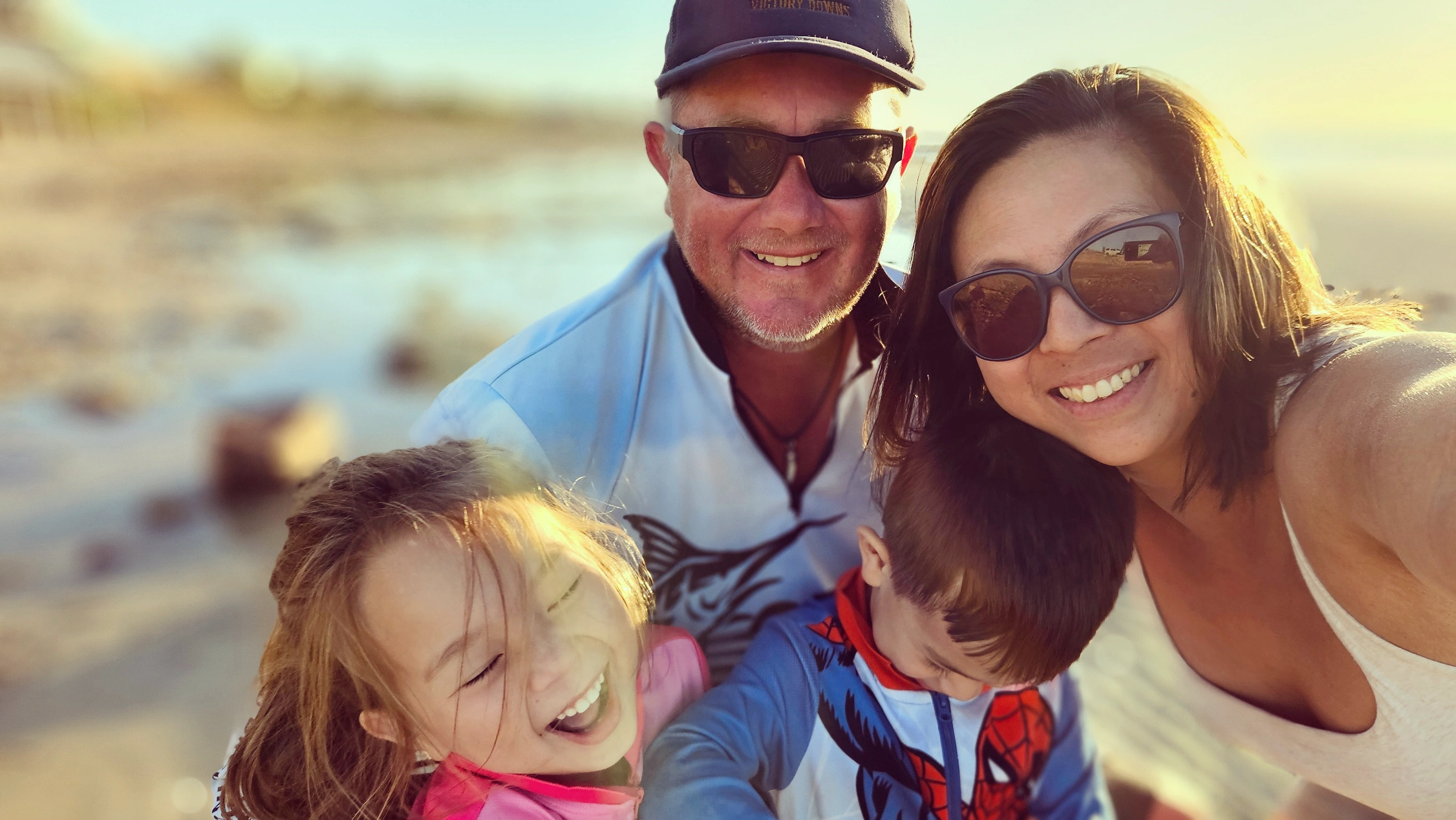
It will be interesting to see where the industry heads next. What many consumers may not realise is just how productive Australian growers have become. Through continual innovation, we’re using the same land and rainfall to produce increasing amounts of food and fibre, and the scale of those increases over the last few decades is astounding. Family farms are businesses driven by generational improvement. We want to earn a living, but just as importantly, we want to improve our soils, farm sustainably, and leave our patch of land in better shape for our kids and the next generation. Those values are a critical part of the story.
Prior to 2023, I worked off-farm as a scientist, and so when I returned to the farm fulltime, one of the things that stood out to me was a gap in learning opportunities for growers. In professional settings, access to networks and ongoing learning is built in, whereas in farming — particularly on the business side — peer-to-peer opportunities can be harder to find. I have a love of learning and wanted to fill some of my own knowledge gaps, which led me to become an ambassador with Women Together Learning (WoTL). Through that network, I’ve helped bring several bespoke learning opportunities to the local area, including risk management, financial literacy, HR and communications. Our roles on farm are so diverse that having the opportunity to deep dive into topics in a safe and accessible way has been really helpful, and also helped establish those wider connections with our community. I’ve also joined Grain Producers South Australia as a member of the Young Grain Producers Committee to broaden my industry network and help bring the voice of a family farm business to the table.
Taking part in the GrainGrowers OnBoard program felt like a natural next step in developing the governance and leadership skills needed beyond the farm gate. What struck me most was that while we’re all in different boats — with different operations, scales and constraints — we’re on the same journey. There’s a shared focus on making sound decisions that support strong farm businesses and resilient rural communities. That long-term thinking is reflected in how we farm every day: managing risk, improving our soils and continually adapting. Doing that work responsibly, knowing it shapes the future in terms of the type of culture and community Duke and Delila will grow up with, is what makes me proud to be an Australian grain grower.