
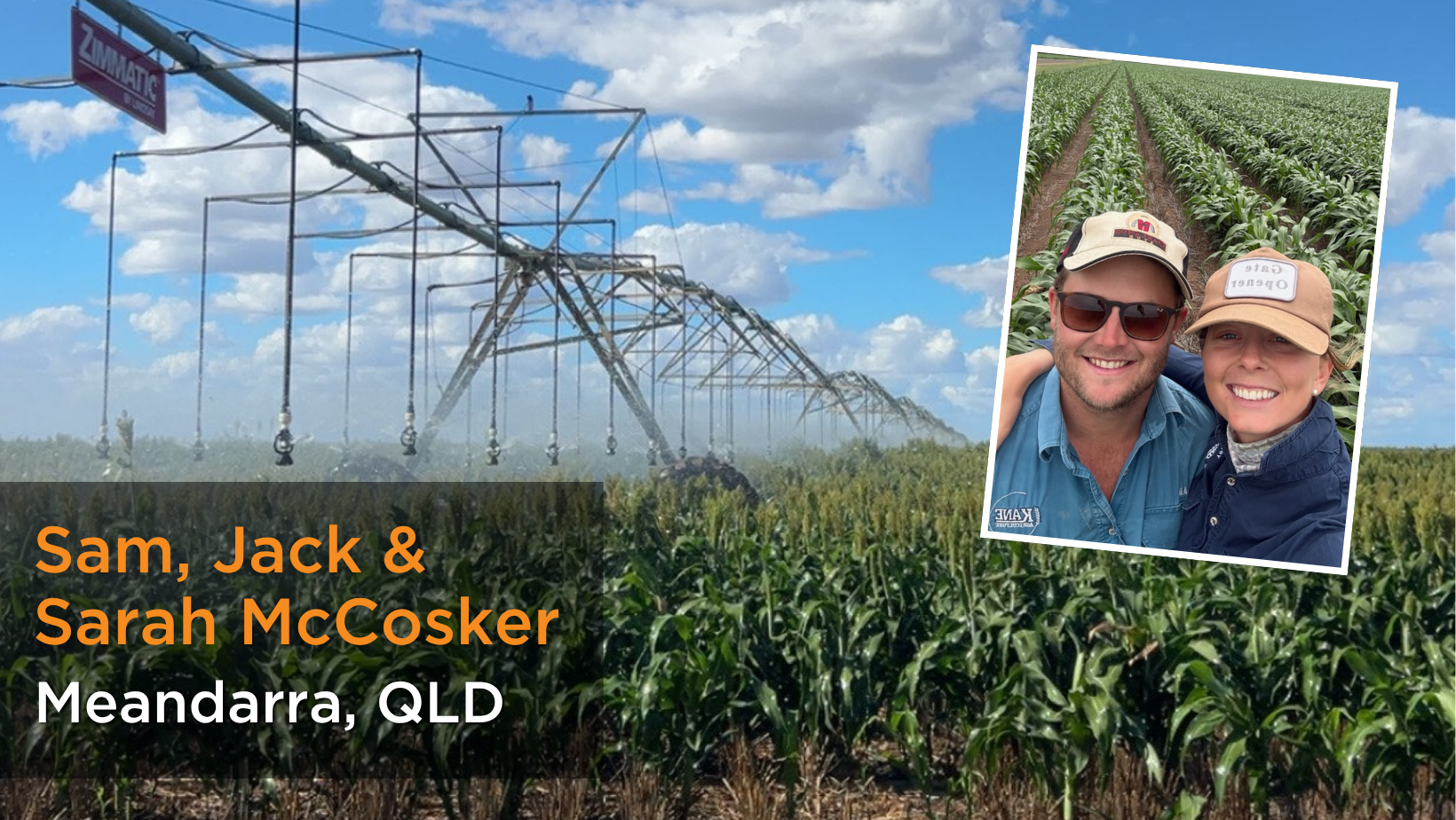
We are the McCosker brothers, Sam and Jack. Our family have been involved in dryland cropping here on the Western Downs for 70 years. In total, we farm around 5,260 ha, and in the last few years, we have branched out, with around 150ha of irrigated crops and a 2,500 head beef cattle feedlot, managed by Sam’s wife, Sarah.
While we find our feet with the irrigation, we are currently doing a rotation of summer and winter crops. We have harvested both wheat and mung beans off the irrigation and down the track we will certainly look at growing irrigated cotton.
Across our cropping area, we have a mix of good self-mulching black to brown clay soils, with some areas along the creek a more red loam, which is fairly common in the area. All our country is contoured, but it is not a heavy undulation; it is just a gradual sloping, which allows the water to drain and minimises erosion.
In a wet year having the contours helps a lot. On the Darling Downs when you get floods in the flat country the water holds, and for months it just stays wet. The contours and the gentle undulations keep things far more manageable.
The last harvest went well enough, considering we had to cope with three hailstorms. We lost probably a couple of tonne to the hectare and typically with hail, it always seems to hit the better parts of the crop, which is disappointing. It was still a good harvest, and we had the crop insured – not the four or five tonnes it was going to be, but to two and a half tonnes – so we did recoup a bit of the cost. It is still disappointing because it is satisfying to harvest a good crop.
The hail did bring a bit of rain, and we had some early sorghum planted, so that helped it along and delivered some positives, along with the negatives. What we harvested in January averaged just under four tonnes per hectare, which was good.
Early last year, we planted and harvested irrigated mungbeans, followed by a wheat crop and we are now waiting to harvest sorghum. We have had some issues with bogging the pivots, so following harvest, we will go in and do a fair bit of maintenance on the banks, sort them out, get them all draining better, and hopefully have fewer problems bogging this time next year.
But it's all a learning curve for us. We have had some repetitions now, and we're sort of learning along the way. We currently have three 50-hectare sites, and we are looking to put in some more pipe work and some more pivot pads. They are movable, towable pivots, so we can rotate them. The aim is for another three sites and once we have that in place, we will be able to fallow the cropping area, and use the water we have more efficiently, essentially giving us more bang for our buck. The theory is that we might get away with using two-thirds of what we have used and still grow a great crop, because the soil can store only 120mm to 140mm.
By moving the pivots, looking at our water use, and taking advantage of fallow periods, we hope to make the most of that bit of our country. In years to come it may also open the door for us to grow some cotton. At the moment, growing multiple crops per year under pivots is a lot of work, so we need to sort out what works best. Part of that is learning to use the pivots and putting a system in place so we achieve a return on our investment.

This time of year is a bit quieter for us, and we are chipping away with some camera spraying and building some contour banks. It is that time of the year when we are getting ready to tackle the broadacre side of things and get organised for planting, so the fuel situation is very concerning, to say the least. The dozer is likely to be put away shortly, and we will be looking closely to see what happens. We will prepare as best we can, and, like other growers, we will spend some time in the shed doing the usual maintenance on planters and equipment to make sure we are good to go.
In more normal circumstances, we would love to be throwing a bit of urea around, but that will not happen. If you can even get a price for urea, you need to think carefully about your soil conditions and water, figure out the potential yield, and work back from there. It’s bad timing, but the fuel and fertiliser situation affects every grower, so we need to just roll with the punches and do what we can.
We will look at expanding the chickpea program to try and use the nitrogen for future plantings. And it would be no real surprise if a lot of growers in our region, depending on price, go back into some chickpeas. The mung beans are an option, but we view them as one of the lazier legumes, and they can be a bit fickle to grow, so we are not going to rely on that. Hopefully, we will manage to get a little bit of fertiliser, and the sums will add up in our favour.
In the future, we will investigate how robotics can help us further. We already use a camera sprayer, but we intend to take it more seriously over the next 18 months or so. With continual improvements to technology we think it could be a lot more viable for us. One of the reasons we purchased a dozer a few years ago was to tidy up our paddocks and take advantage of new technologies. There will certainly be a push toward new approaches in the coming years.
If you look at camera sprayers, a few years ago they were running 12m booms and 1,000l tanks. That has certainly changed over the last five years, as they are now big machines that can cover a lot of country in a short period of time. The autofill system, when it finally arrives, will be an absolute game-changer. Having a machine that can just about look after itself will be so much better for weed control, because if you are too busy doing something else, the robot can get on with the things early and stay ahead of the weeds.
Despite all the issues that we face in growing a crop, we both genuinely enjoy what we are doing. When we finished school, there was never any pressure to take over the farm. But we both decided to come home, and after a few years Mum and Dad suggested Marcus Oldham would be a great idea. The Ag Business Diploma was eye-opening for us both, and while there was never a handover day, from the time we came home, they started a slow transition period to step aside and give us more responsibility.
One of the biggest positives we've found is that both Mum and Dad were equally involved in the business. They were both young enough when the transition started and were still very much involved in the day-to-day operations, so that when we made a mistake, they could pull us back on track. We have been very fortunate that our parents have encouraged us and allowed us to step into the business and take the reins. It has been our decision to build the feedlot, install the irrigation, and build the storage dam. And our parents have supported us and allowed us to do that because they can see us building our future.
What motivates us is doing a good job, and over time we have built a strong team around us, including agronomy support, to help us do that. From our viewpoint, everything's going along pretty well, and we're excited for the future.
Feedlots and family
Marrying into a farming family can have its challenges, particularly when the farm has transitioned from being managed by the parents to being managed by brothers with plenty of ideas for the future. But for Sarah McCosker, the challenge, including the development of a beef feedlot as part of the farming operations has given her a clear role and sense of responsibility.
I was born and raised on a smaller dryland and irrigation farm on the Darling Downs, so when I married Sam, I already had a good understanding of farm life. Before we married, I had been working in the Northern Territory and Western Australia, and I was very keen to move back to Queensland.
To be honest, it was very daunting at the start. A big part of my identity was travelling and spending time working on cattle stations, so settling down and stepping away from that lifestyle was a significant change. Thankfully, it has been very seamless and the Feedlot has given me a sense of purpose.
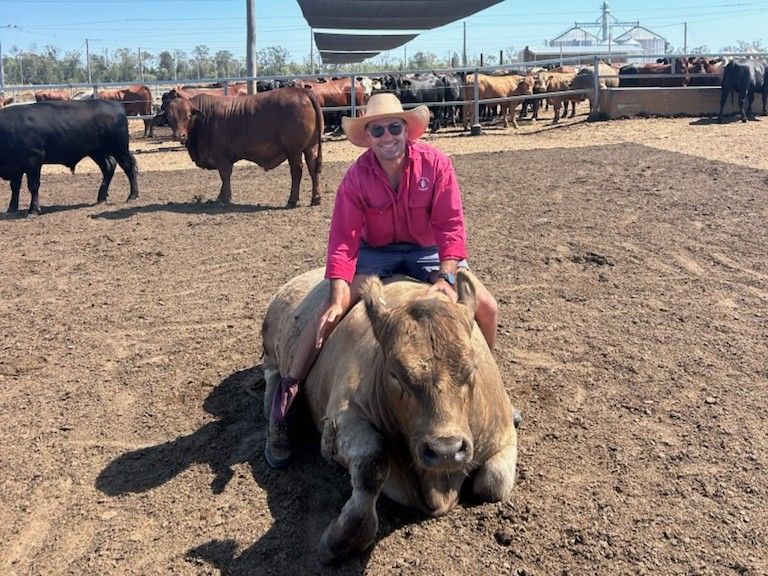
When I moved to the farm a year ago, we had just started the feedlot, so I came along and took it under my wing. Before running our own feedlot, I had never been to one, so it was a steep learning curve, and I leaned heavily on the people around us, including, our cattle agent, nutritionist and vet. It was very much tackling one thing at a time, but with my qualifications - Bachelor of Veterinary Technology – and background with livestock, I was reasonably well equipped to figure it out. Currently, it is running well, and I am focusing on getting the best performance from our steers and tracking their progress throughout their feeding period and at the abattoir.
Sam and Jack are now running the operation, so the family dynamic has changed. We each have our own roles across the farm and business, and while we focus on our individual areas, we also step in and help each other when needed. Every decision on the farm is made together, but we each take responsibility for our own section and ensure it is up to date. While there has been a steep learning curve with the inclusion of the feedlot and irrigation, the teamwork and the family decision-making make it much more manageable.
While we have plenty of informal catch-ups, we are trying to hold monthly, more formal meetings to update everyone on each aspect of the business and ensure everyone is happy with what is going on.
We are currently in a transition period, with staff changes and plans to expand the feedlot later this year. When we double the feedlot capacity and make it work a little harder, our irrigation country needs to increase as well to support that expansion. As we are organising that, I will continue to manage the daily operations at the feedlot and ensure we are on top of our compliance, data management and analysis. It is all about getting the foundations right and maintaining a high level of production while we continue to grow the business.
One of the reasons the growth has been so successful is that the McCoskers have backed me 100%, even when I didn’t back myself. The approach has been one of stick to your guns and learn from our mistakes, and thankfully, I have had the support around me to allow me to do just that.