
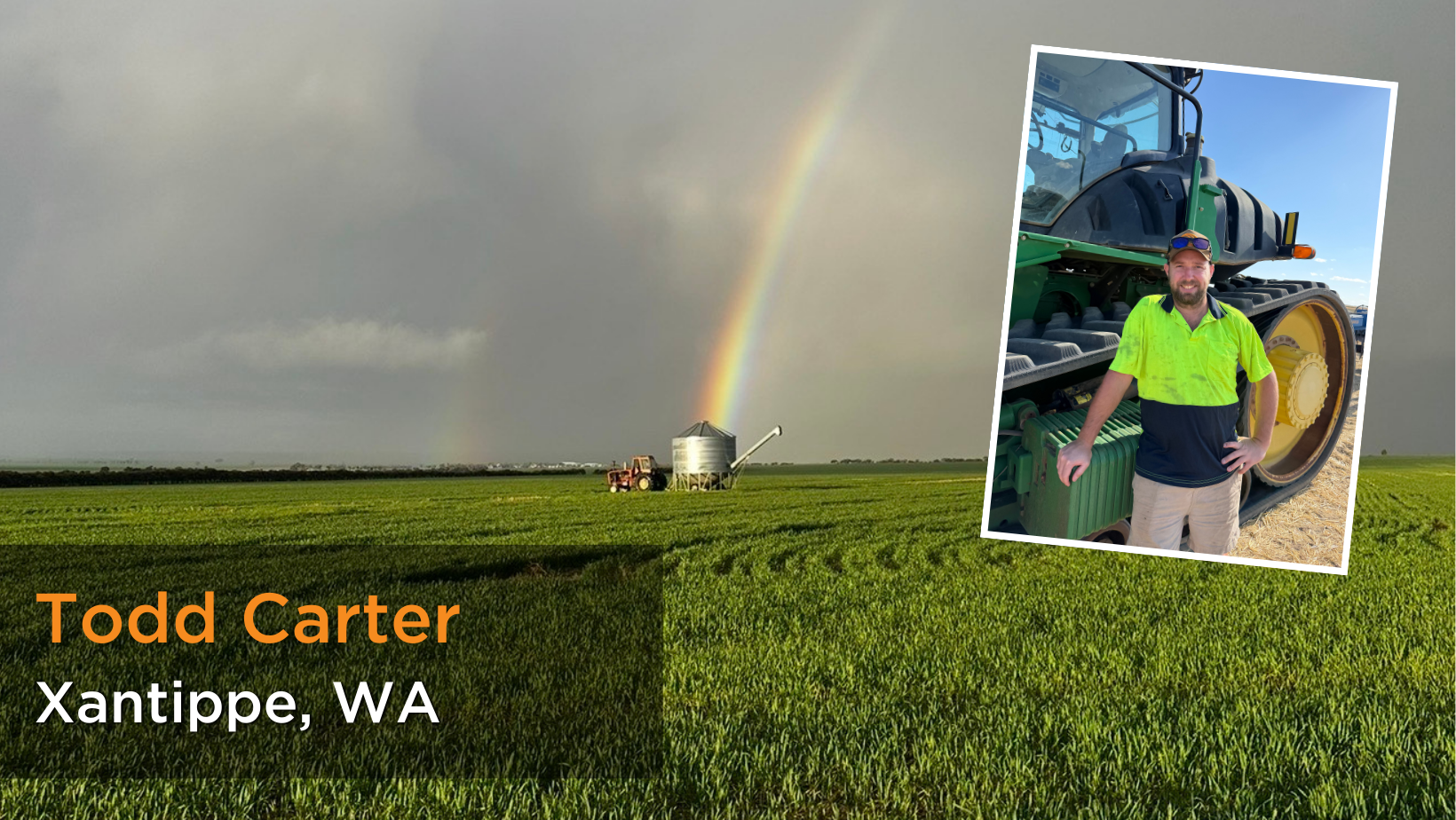
Hi, I’m Todd Carter, and I farm at Xantippe in the Central Wheatbelt, about 300 km northeast of Perth and 40 km east of Dalwallinu. We run about 10,400 hectares and cropped 8,400 hectares in 2025.
This has been our biggest cropping year so far, as the sheep side of things, like for a lot of people in WA, has been scaled back. We planted canola, all Roundup Ready, with Emu and Hunter as the varieties. For wheat, around 60% was Vixen, with Sceptre and Tomahawk making up the rest. We did have some barley, but it was a pretty small part of the program overall. We kept our pasture rotation where we felt comfortable managing it alongside cropping and sheep.
With inputs, the way the season started meant we were fairly conservative early in seeding, with the forecast looking pretty average, but we still tried to stay close to fertiliser recommendations. As the season improved, we pushed rates up to take advantage of it. We ended up with some fairly high nitrogen numbers spread between urea and Flexi-N. Looking back, some spreader calibrations pushed rates a bit higher than planned, which actually worked perfectly for the season. If the start had been a bit better, it would have been a pretty unreal year.
Our soils are really colour variable, which, along with soil testing, yield maps, biomass and just knowing the place, makes planning and VRT mapping more than just a guess.
Harvest was a bit of a mixed bag. We started on some early barley around the 22nd of October, but then ran into issues with canola being a bit green, which led to some interesting words being said. While we waited for that to dry out, we kept rolling through cereals and then jumped back into canola. We were probably lucky the season stayed cool through October and November and we didn’t get any big wind events. We did see a few missed patches get smashed by storms, but thankfully we’d already moved on from those areas.
The grain in the bin was better than we’d estimated, with yields ranging from around 2 to 5 tonnes a hectare, and some country doing better than we ever expected. Canola was a bit of a letdown at about 1.3 tonnes, wheat across the program averaged about 2.7, and barley around 3. We had some really good paddocks, but the slow start and the fact we kept putting more crop in dragged seeding out. We probably lost a bit of top-end yield in the later stuff, but it was still well worth growing and returned some strong margins.
Quality was better than expected, with grades from AWW2 through to H2. We did a fair bit of paddock mixing, which slowed things down but was definitely worth it. We’re not totally sure why quality was so strong. Our best guess is nitrogen has built up over the last couple of seasons, along with late finishing rains and a cool October. Either way, it was good to see results like that across a big area.
We’ve looked at on-farm storage, but the upfront cost makes it hard to justify at this stage. It’s also hard to work out what size you need, when one year you might only grow 3,000 tonnes and the next year it could be over 20,000. That sort of swing makes it tricky to make the numbers stack up.
Where we have spent money is on upgrading our spraying with drone tech. We’ve done some green-on-green and, while it was a steep learning curve, it’s worked pretty well overall and we’ll definitely keep doing more of it. For green-on-brown, we’ve mapped about 3,000 hectares using a drone with the SingleAg camera and software. It’s been a handy tool, as we can now do a full paddock check far more efficiently and accurately than just checking paddocks by eye.
Spot spraying for weeds has saved us anywhere from 60 to 98% in herbicides alone. We’re even picking up things like dying caltrop with the SingleAg system, where I’ve heard other systems struggle. These figures don’t include completely clean areas we now bypass in the sprayer because we know the weed distribution before spraying. If that was factored in properly, the savings would look even better. It’s lowered costs while still letting us push label rates, knowing we come out in front but kill the weed the first time. We saved about $6,000 over 1,200 hectares in one week in January just on chemical, and that’s before you even count time and water. It’s been especially handy when trying to juggle holidays and work.
We’re pretty confident in the maps now. On an average day you can easily map 800 to 1,000 hectares with the drone. We haven’t really pushed full days yet, because the sprayer becomes the bottleneck anyway. After processing, you can sit down and look over the paddocks on the laptop, see where the weeds are, and tweak mixes to suit.
Before this, we were basically just driving paddocks, eyeballing weed pressure, guessing how much to spray and hoping for the best. I reckon a lot of people still do it that way, and we were no different not that long ago. When we first started with drone mapping a few years back it was a lot of work, but it’s only getting easier and better.
I work with my brother Gavin, along with my dad Steve, who hasn’t taken a break from farming since day one and shows no signs of slowing down. At harvest we usually have three or four extra people, and we use contractors for most of our cartage. It just makes sense, because you can’t do everything yourself.
Now harvest is done, we’re trying to take a breather, if you can call it that, while still getting through the usual maintenance before it all starts again. That’s probably a good thing, because my wife Katrina, our son Lachlan and I have just welcomed our new son Henry into the world. Having a bit of family time will be something we really appreciate.
Like everyone, I’ve got high hopes for 2026, but it’s always a case of wait and see what the season throws at you.