
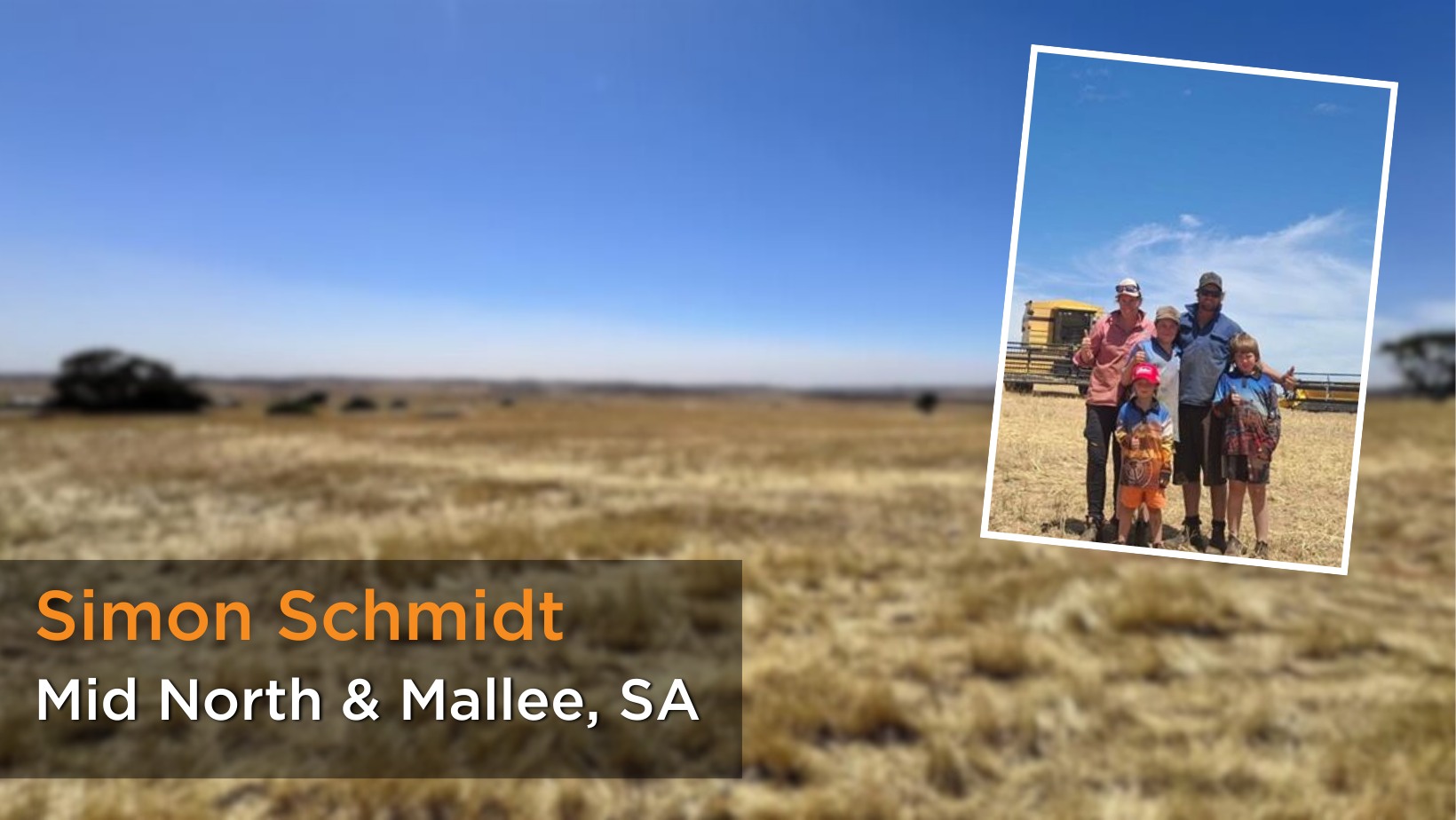
Hi, my name is Simon Schmidt, and I farm with my wife Steph and our three kids, Ted, Angus and Darcy, across properties in South Australia’s Mid North and Mallee. We run a mixed cropping and sheep enterprise, and like many growers in South Australia, we’ve been riding out tough seasons of marginal rainfall.
On our properties, the soil tells the story of contrast, limestone rises and heavy clay flats in the Mid North compared to deep sands and light loams in the Mallee. We work through three or four soil types in one paddock, and that’s where variable-rate gear earns its keep. In the Mallee, we try and pump more fertiliser into the sandy rises and less on the flats, to try and get more productivity from our sandhills.
Wheat and barley have always been our mainstay crops. Wheat has generally been the reliable performer in most of the lean years, while barley can be hit and miss, often coming up short when the season tightens. We’ve tried peas, oats for hay and other options, but the seasons haven’t often been kind.
The biggest issue we face is our opening rains, they’re not what they used to be. You wait and wait for the break, and when it comes, it’s eight or ten millimetres, not the inch you need. Then you’re pushing dry sowing and praying for a follow-up that isn’t guaranteed to arrive.
We acknowledge that we farm in marginal country, and we have always farmed accordingly – e.g. we don’t just keep seed for the next season, we will always keep seed for the following two seasons. However, since 2017, the dry years have been exceptionally tough. We had some reprieve in 2022, but in reality, for the past 8 years, it really feels like we have been deep in drought or just trying to keep our heads above water. The main way we have continued to get by is by working incredibly hard, both myself and now my family as they get older. Working hard together is what gets us through.
When the season does deliver like it did in 2016, harvest is a race against heat and time. Headers thunder across the paddocks, throwing dust plumes into the sky like smoke signals. Grain trucks rumble down sandy tracks, and the kids swap motorbikes for cab seats without missing a beat.
Our eleven-year-old son, Ted, gets stuck in at harvest like he’s been doing it for decades. “I like harvest because it's better in the air-con than out fencing!” Ted grins. He taught himself to shear at nine and competed in the Eudunda shearing competition at 10. “Now I can do 40 lambs a day,” he says proudly.
On the other hand, our eight-year-old, Angus, is the fixer. “I like mustering sheep and fixing stuff,” Angus says, wiping dust off his hands. Darcy, our five-year-old, is never far behind and is always keen to help and soak up every move his brothers make. He also likes jumping in the truck with me and helping to muster the sheep and goats.
The rhythm is relentless – headers, field bins, trucks – but for us, it’s the payoff for months of dust and hope. And it’s not just grain. Our sheep and wool are 50% of our farming program, but have been the primary income that have got us through the drought. As well as our sheep, the kids even run a goat enterprise, mustering ferals off the edges and selling to a local abattoir when the numbers stack up. “We caught 100 once,” Ted says. “And we managed to bring 70 of them in”. It’s not only pocket money for them, but a lesson in grit – keep moving, find value and work the landscape that’s in front of you.
Despite the challenges, I see an opportunity in marginal farming. We can produce some of the cleanest, best wheat in the world without heavy inputs. We’re lucky that disease pressure is low where we farm, compared with other growing regions. Ted puts it simply: “People should know where their food comes from. We do.”
Community matters too, even as rural towns shrink. For us, the biggest worry is that towns aren’t growing and we need housing and people. There’s so much opportunity out here. Since 2016, we’ve seen our neighbours scale back, lease out, or leave. This has been happening in a lot of marginal areas since 2016, when we’ve been in drought years. The pressure of the drought and high input costs has made it impossible for a lot of people to keep going. Still, we keep showing up for our patchwork of communities from the Mid North to the Mallee, betting on the next turn of the season.
In five years' time, I hope we can have a couple of good seasons behind us. I don’t mind getting up every day and putting in the effort, so long as you get something back – but after the past 8 years of battling through without much return, there have been a lot of tough days and seasons, we can’t keep going in survival mode forever without some better seasons. For the kids, Ted’s plan is pretty simple: “Farming and shearing. That’s what I want to do.” Angus nods, “And fixing stuff.”
You’ve got to keep going. If you look back, you’re not going to get anywhere so looking to the future is the only option. And with the kids revving their bikes, grinning through the grit, I already know the next generation is ready to ride straight into whatever comes next.