

Australia has many pieces of legislation and associated regulation at both federal and state level addressing environmental impacts, and which frequently claim (in their “purposes” or in supporting documentation) to be based on the principles of ecological sustainable development.
A landmark report that introduced the concept of sustainable development was the Brundtland Report, which emphasised the interdependence on economic growth, environmental protection, and social equity, and hence recognised that environmental regulation had to balance the costs imposed elsewhere.
Where the costs imposed by a given requirement are out of proportion to the environmental benefits achieved, the informal term “green tape” is often applied.
Review of “Green Tape”
GrainGrowers recently commissioned a review by Aton Consulting Pty Ltd to assess the effectiveness of over 60 pieces of Commonwealth and State environmental legislation impacting the grain sector. Alongside a desktop review, Aton conducted interviews with growers and other grain value chain participants to gain a perspective of their understanding of “green tape” and its impact on day to day operations. The findings highlight both the benefits and burdens of current legislation, offering key insights and recommendations for improvement.
Effective vs Ineffective Legislation
Rather than framing the review under the informal lens of green tape, the report defines environmental legislation as either effective or ineffective.
Effective environmental legislation supports growers by providing clarity, reducing costs, and encouraging innovation. For example, the report found that pesticide legislation is seen as a valuable tool for maintaining market access, especially when technology simplifies the process of reporting. Such legislation not only improves profitability but also enhances farm wellbeing by reducing financial and operational risks.
On the other hand, ineffective environmental legislation is often unclear, duplicative, and overly complex. This creates significant financial and mental stress for growers, particularly those with limited resources. For instance, land use involves a tangled mix of local, state, territory, and Commonwealth laws, leading to uncertainty and frequent power imbalances.
Key insights from interview participants
Interviews highlighted that growers recognised effective environmental legislation offered a clear value proposition that supported their operations both financially and environmentally. Growers are aware of the importance of strong environmental outcomes and green tape does have a role in encouraging innovation that improves profitability through productivity gains, and reduced risks and costs. These factors also lead to improved farmer well-being through reduced financial burden, operational risk, compliance and reporting.
However, poorly designed green tape has a significant financial and mental health cost with its complexity, duplication and one-size-fits-all approach making compliance burdensome and inequitable (Figure 1). For growers with limited resources, green tape can be a barrier to accessing potential benefits and may result in legislation failing to deliver desired environmental outcomes.

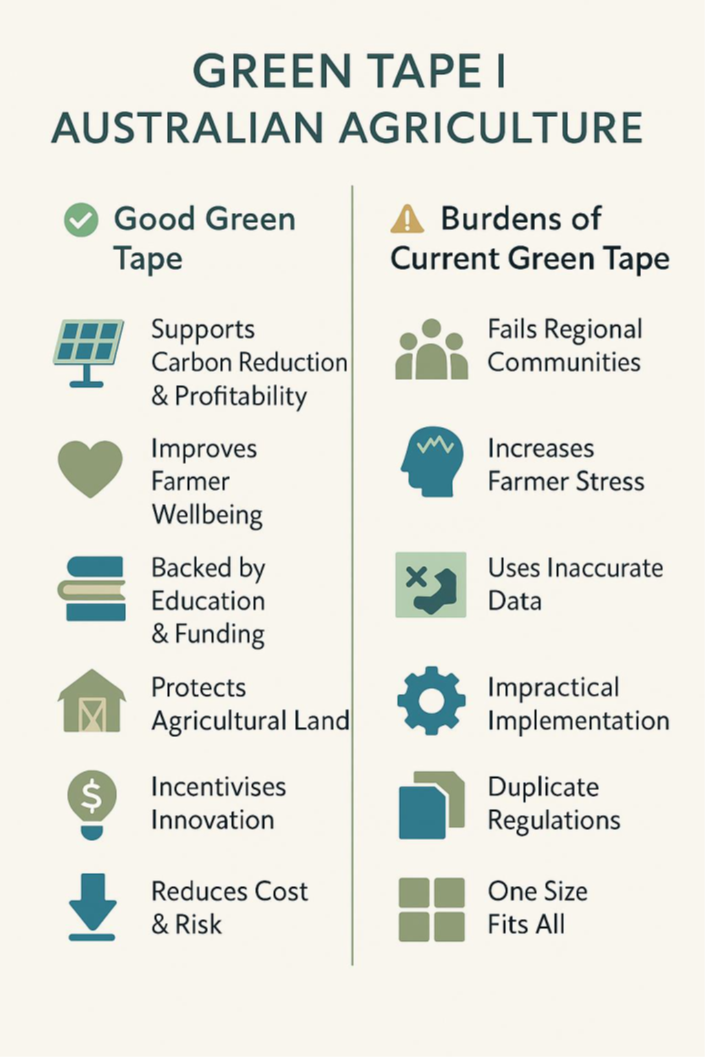
Growers interviewed highlighted the importance of transparency to reduce farmer stress and avoid impractical implementation of new legislation, such as the incoming mandatory climate reporting. One grower expressed concern about the "radio silence" around the requirements for this new reporting and a lack of understanding among growers about the implications.
An accountant stressed the need for more transparency, specifically in relation to environmental markets and the potential financial implications for growers wishing to participate, "there are income and capital gains tax implications around ACCUs and potentially nature credits that are not clear or well explained. This is potentially a disincentive to undertake projects."
Finally, the duplication of legislation was a concern raised by many, with one value chain participant noting that "Bilateral agreements are not working. Multiple levels of approvals mean clients are receiving approvals for vegetation clearing from one authority and then being fined by another for illegal actions."
Key Challenges Identified
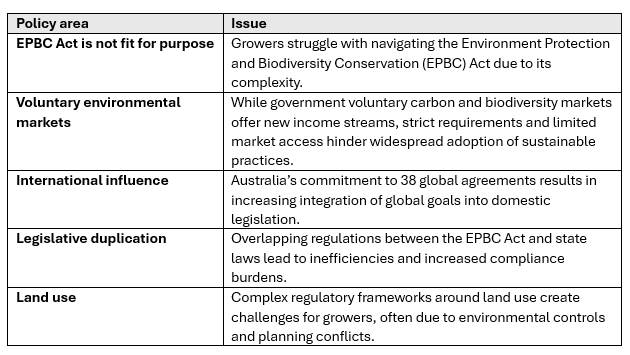
Through conversations with growers and the broader grain value chain, and extensive desktop research, the report identified several key challenges with existing environmental legislation (Table 1).

Suggested Focus Areas for GrainGrowers
To address these challenges, the report recommends that GrainGrowers focus, or increase focus, on the following key areas:
- Nature Positive and EPBC reform: Strengthen bilateral agreements and reward growers for implementing sustainable practices.
- Knowledge and capability: Secure government funding for regional knowledge hubs to support growers navigating legislation and environmental markets.
- Environmental data rights: Advocate for legislation recognising growers’ ownership and value of environmental data, enabling potential new revenue streams.
- Taxation clarity: Seek greater transparency on the financial and tax treatment of environmental scheme outcomes to encourage participation.
- Mental health: Embed mental health considerations in legislative reform to reduce unnecessary regulatory burden and stress.
- Voluntary and global frameworks: Ensure emerging reporting schemes and international commitments do not impose disproportionate compliance obligations on growers.
While effective environmental legislation can drive innovation, profitability, and sustainability, poorly designed laws can impose significant burdens on growers. By addressing the challenges and focusing on the suggested areas for improvement, the grains industry can better navigate environmental regulations and unlock new opportunities for growth and sustainability.
How GrainGrowers is implementing these recommendations
GrainGrowers is actively progressing recommendations across advocacy, policy engagement and grower support. GrainGrowers focus is practical: ensuring environmental reform delivers positive outcomes without imposing unnecessary cost, complexity or risk on growers.
1. Nature Positive and EPBC reform
GrainGrowers has been extensively involved in discussions and consultations on reform of the Environment Protection and Biodiversity Conservation (EPBC) Act, including advocacy for streamlined bilateral arrangements to reduce duplication and improve regulatory efficiency.
Engagement in the Nature Positive agenda is focused on ensuring policy settings recognise and reward growers already delivering strong environmental outcomes. Advocacy centres on practical mechanisms that incentivise positive behaviour rather than layering additional compliance obligations onto farm businesses.
2. Knowledge and capability
Knowledge and capability are central to the GrainGrowers’ Climate Change Policy. Key priorities include:
- Increased investment in climate-focused extension programs to provide growers with practical, regionally relevant information.
- Clear, evidence-based demonstrations of how mitigation and adaptation practices affect productivity, profitability and emissions.
- Improved guidance on market pathways so growers can capture value beyond carbon markets.
- Targeted funding to strengthen the capacity of agronomists, advisors and extension providers to support climate‑smart adoption.
The objective is to ensure growers are equipped to make informed commercial decisions in a changing policy and market environment.
3. Environmental data rights
As sustainability reporting expectations increase across supply chains, GrainGrowers continues to advocate for fair treatment of growers’ data.
This includes advocating for appropriate compensation where growers are asked to provide sustainability data to meet corporate reporting or ambition targets, and advocating against mandatory farm-level emissions disclosure under climate-related financial reporting frameworks.
Regulatory clarity has been secured through a Department of Agriculture, Fisheries and Forestry (DAFF) fact sheet released in early 2026 confirming there is no legislative requirement for growers to provide farm-level data on request.
4. Taxation clarity
Through the 2026-27 Pre-Budget submission, GrainGrowers has called for a review of off-farm income tax settings that may inadvertently penalise growers participating in sustainability activities on private agricultural land.
Engagement with agricultural organisations and the renewables sector is also underway to address tax-related disincentives that may discourage income diversification.
5. Mental health
GrainGrowers recognises that policy settings can have impacts beyond compliance costs. Active engagement in environmental policy consultations seeks to minimise unnecessary regulatory burden on growers.
Mental health considerations are increasingly incorporated into advocacy on climate-related financial disclosures, EPBC reform and other environmental frameworks. Legislative design must consider the cumulative stress and uncertainty placed on farm businesses.
6. Voluntary and global frameworks
As voluntary sustainability reporting and global frameworks continue to evolve, GrainGrowers is working to ensure growers are informed and prepared.
Grower dinners have been hosted on climate-related financial disclosure, and a report on natural capital reporting has been produced, including recommendations to minimise potential administrative burdens associated with frameworks such as the Taskforce on Nature-related Financial Disclosures (TNFD).
A set of sustainability certification principles endorsed by the National Policy Group has been developed to guide advocacy and industry engagement.
At a national level, GrainGrowers has advocated against the introduction of sector-specific agricultural targets under Australia’s updated climate commitments and engaged with the Department of Climate Change, Energy, the Environment and Water (DCCEEW) on development of the Agriculture and Land Sector Plan. This engagement supports a practical and proportionate approach to the sector’s contribution to national climate targets.
A Practical and Proportionate Approach
Across all areas, GrainGrowers approach remains consistent: support growers with knowledge and clarity, advocate for fair and workable policy settings, and ensure environmental reform strengthens the resilience and competitiveness of Australian grain businesses.