
If you’re expecting a horror story, relax. The ghost I’m talking about isn’t rattling chains in the creepy old stable. It’s not even about Ghost in the Machine, the fourth studio album by The Police, released in1981.
It’s from Arthur Koestler’s novel The Ghost in the Machine and it’s his way of explaining how complex systems really work, with hidden layers quietly steering behaviour while the obvious parts take the credit. In Australian agriculture, that ghost has often been women: essential to the system, somehow edited out of the label.
This year’s IWD theme Balance the Scales is about more than vibes and cupcakes. It’s about fixing the machinery itself: addressing systemic inequalities, improving safety, and ensuring our legal and administrative systems are fair and accessible for women. In other words, it’s time to stop pretending the ghost is optional and admit she’s been driving the header the whole time (and logging the finance meeting, organising the parts run, and making sure everyone ate something besides a YOLO sausage roll).
Reality led. Law followed. Culture lagged. Recognition came last.
For generations, Australian grain growing has been framed through the same lens: the majestic Australian wheat at golden hour, the header in full swing, silos rising against the skyline, and a team of men at the centre of the action. But it has never been the full story. For two centuries, a quieter truth has been whispering under the engine noise:
Women were never the side quest. They were the system. The ghost in the machine.
When we look at our grain growing history, the lag wasn’t women’s participation. The lag was recognition. The forces that finally pushed recognition forward tell us where agriculture is heading next.
Property, power, and permission
In the 1800s, women sowed, harvested, managed stock and, when required, ran whole properties across the wheat belts. But under British common law, married women’s property legally belonged to their husbands. Enter the Married Women’s Property Acts: not instant feminism in a can, but a crucial change. For the first time, married women could own land, enter contracts, and control earnings. Reality existed; the law finally noticed. Think of it as the world’s most overdue name tag.
War: the (reluctant) legitimiser
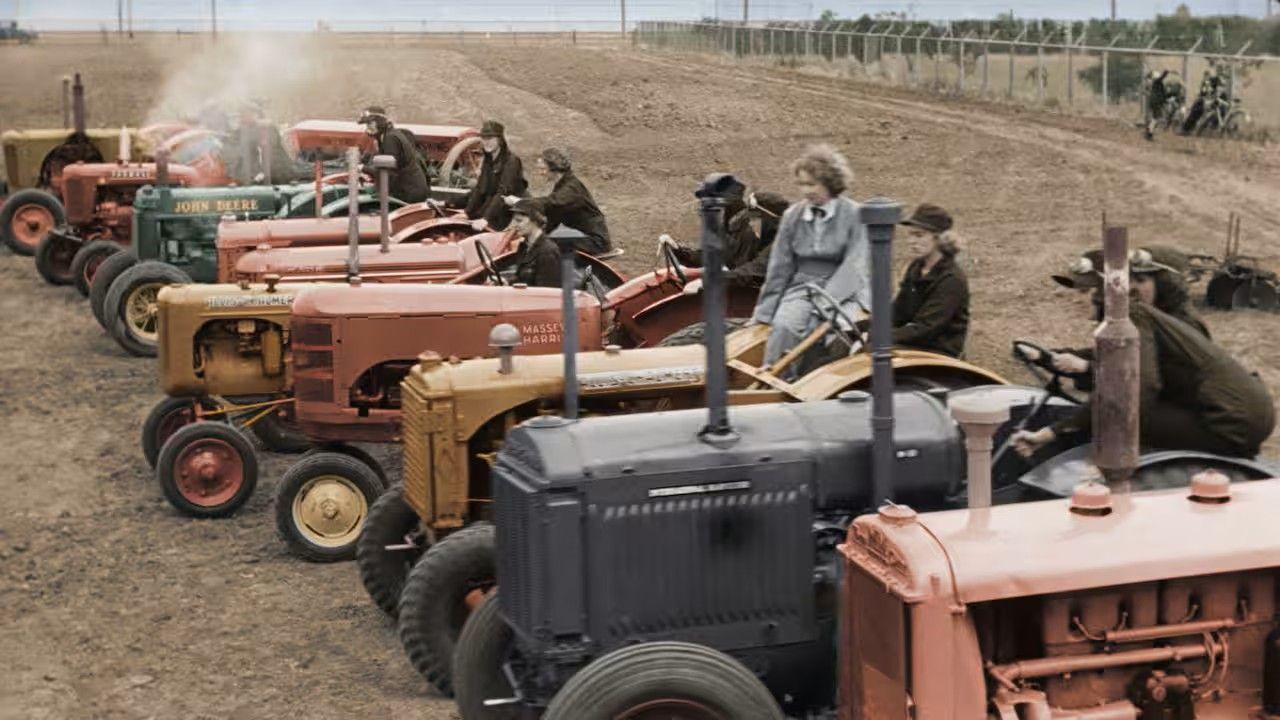
Crisis has a brutal way of fast‑tracking truth. During WWII, the Australian Women’s Land Army filled labour shortages in agriculture, including wheat. Women drove tractors and operated headers not as a gesture, but as a necessity. Post‑war, many were nudged back to the wings, but the glass gearbox was already cracked: capability had been seen, not theorised.
The invisible managers
From the 1950s to the 1980s, the cultural image of the male wheat farmer hardened even as the business model modernised. Mechanisation reduced reliance on brawn. Grain enterprises became capital intensive, data heavy, risk managed businesses. Women increasingly:
- Ran the books and compliance
- Negotiated finance
- Coordinated logistics
- Worked off‑farm to steady cash flow
- Stepped into operations at peak moments.
And yet the forms, the bank manager’s gaze, and the industry paperwork often defaulted to the farmer as male. The person managing risk wasn’t always the person recognised as the operator. (A bit like watching the credits roll and discovering the lead actor is listed as “Supportive Friend #2”.)
Law reform and the price of recognition
The reform era of the 1970s and 80s i.e. anti‑discrimination laws, better access to credit and joint land titles, sounds administrative. It wasn’t. In grains, capital is power, power determines scale, and scale shapes influence. When women could be on the title, on the loan, and on the board, the system began to match reality. Culture called a code slow, but the gates were finally opening.
Proving competence
By the 1990s and 2000s, the conversation finally shifted from “Can women farm?” to the much more accurate “Obviously. Who’s next?”
A major catalyst in this shift was Australian Women in Agriculture, founded in 1993. It played a significant role in advocating for women’s recognition in agriculture, creating a platform, a presence, and a collective voice. Just a year later, in the 1994 census, women were officially permitted to list their occupation as farmer for the first time instead of helpmate or farmer’s wife. *
Normalising authority
Meanwhile, programs like the Rural Women’s Development Program were quietly building governance and business capability long before ‘leadership pipeline’ became a thing. Industry bodies like GrainGrowers and NSW Farmers began elevating women into board roles and policy spaces. Not as accessories. As operators.
At the same time, women poured into agricultural universities; female agronomists became part of the everyday landscape; and media finally started profiling women managing large‑scale grain enterprises. The shift wasn’t about proving competence anymore. That had been demonstrated for generations. It was about normalising authority expecting women to lead, decide, and set direction, not just ‘help’.
Five crank handles that turned the machine
Across two centuries, these forces reliably shifted the gears:
- Law: property rights, anti‑discrimination, the dry but mighty stuff.
- Labour shocks: wars and crises exposing what women were already capable of.
- Finance: access to credit turning invisible labour into recognised enterprise.
- Education: ag science, business training, and pathways that stick.
- Governance: programs, boards, and decision-making‑ rooms that finally opened their doors. Hello Women on Agricultural Boards program!
And yes, the cultural vibe was still on a code slow. It usually does until the balance tips and suddenly ‘Wow. New.’ looks suspiciously like ‘Always present. Now visible.’
Why this matters now
Modern grain enterprises are complex: climate volatility, biosecurity, compliance, global trade, data, governance. Today’s risk managed business model rewards skills many women have honed for decades and often without title. Financial literacy. Governance know how. Risk strategy. Stakeholder engagement. Systems thinking. None of this is helping on the farm. It’s running one.
And a note made with care: conversations about First Nations women in agriculture must be led by First Nations women. The invitation is to platform, fund, and follow their leadership and not to speak on their behalf.
The unfinished work
- Women still hold a minority of agricultural land titles outright.
- Board and committee representation is better, but uneven.
- Succession planning still defaults to the eldest son in too many family scripts.
- Disability, safety and legal access need better data, better systems, and quicker remedies.
Which brings us back to our IWD theme: Balance the Scales. Not with speeches alone (lovely though they are), but with systems that are fair, safe, and accessible.
What balancing looks like
- Name the operator: titles, ABNs, insurance, bank accounts. If she runs it, she’s on it.
- Fair finance: equal access to credit, collateral frameworks that recognise joint contribution.
- Inclusive succession: plan by skills and interest, not birth order or gender.
- Count what counts: collect and publish workforce data across gender, age, cultural and linguistic diversity, and disability, because what gets measured gets managed.
- Safety first: policies, training, and reporting that are actually used (and funded).
- Governance pathways: programming, paid time, mentoring, childcare support and travel budgets that make leadership realistic, not heroic.
No side quest
The story of women in grain isn’t a late arrival plot twist or surprise witness in a courtroom drama. From ledgers to loaders, from lime to LandCruisers, women have always been there. The shift was never about capability. It was about the system catching up.
Women were never the supporting act in Australian grains. They have always been part of the machine as operators, leaders and decision makers.
This IWD, we acknowledge and value the ghost in the machine, and make sure women are working the gears of every decision. We don’t exorcise the ghost; we put her on the title, hand her the mic and pay her invoice on time.
*Fun fact: Victoria’s 1891 census counted livestock, but not women farmers
Words by Sarah Hyland.
Image: Scenes of women working on the land during the Second World War. Source: Australia In Colour
The Australian Women’s Land Army was formed in 1942 to combat rising labour shortages in the farming sector. Women from the city who were unskilled in agricultural labour were trained up and sent to farms where they kept food production going.